
Book 2 · The Stay Safe Series · Look inside
Look inside Stay Safe at Home
Read Chapter 1, the Introduction, free on this page, exactly as it appears in the book.

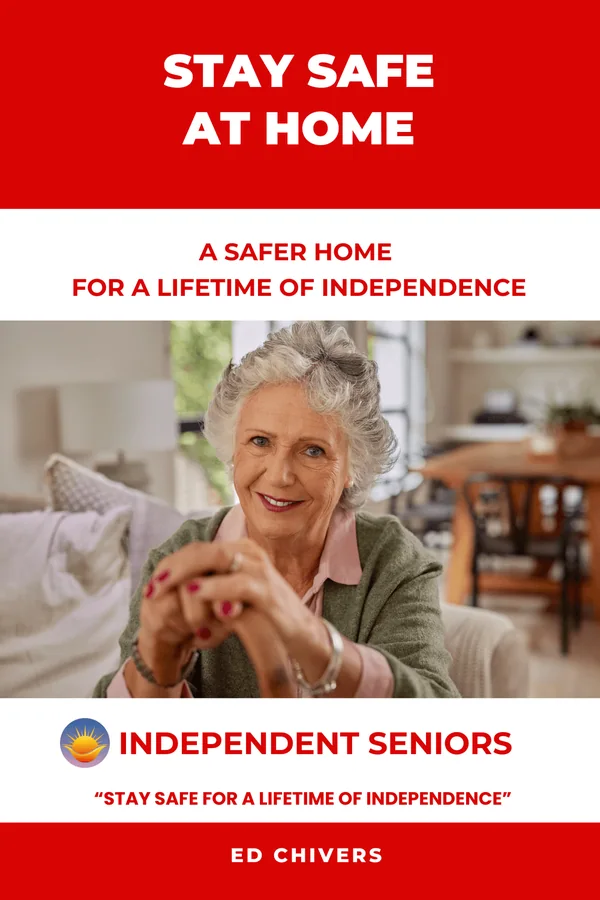
Free chapter
This is the same free chapter you can read in the Independent Seniors Toolkit. No sign-up, nothing to install.
Like what you read? The whole book is simple, low-cost fixes that make every room of your home safer.
Chapter 1: Introduction
I wrote this book to help seniors avoid home accidents and enjoy their lifetime of independence. My motivation was due to becoming aware of the unnecessary tragedies happening around my friends and myself.
Some Sobering Facts For Seniors
This book isn't out to frighten you. The numbers are real, though. But it’s important to be aware of the scale and impact of these accidents. I will keep it brief here, and details of references can be found in chapter 27.
Did you know that:
- 1 in 4 seniors falls every year, but less than half tell their doctor. [2]
- 79% of fall related ER visits happen at home, not on sidewalks or trails. [23]
- The majority of serious home accidents among older adults are preventable. [1, 2, 19]
- The good news is Home Modification programs have been shown to reduce fall rates by 30-50% [1, 2], and up to 55% [21].
Prevention is not merely advisable. For most people, it is the only reliable option as recovery from serious injury is poor:
- Fewer than half of hip fracture survivors regain pre-fracture functional status. [18]
- 1 in 4 die within a year [20, 39].
Everyday household items, from throw rugs to furniture and mobility aids, send more than three million seniors to the hospital annually and contribute to over 41,000 deaths, according to the US Consumer Product Safety Commission. [50]
And for Seniors who break a hip:
About 20 to 30 percent of seniors die within a year of breaking a hip, and roughly half never fully regain their previous level of independence or get back to their old living situation, often needing long-term nursing care instead [1, 20, 39]. Falls, which cause most hip fractures, are already the leading cause of both fatal and non-fatal injury for adults 65 and older [1]. Survivors often face ongoing mobility decline and a higher chance of needing institutional care on top of everything else. (Refer to the medRxiv preprint server, “Determinants of One-Year Mortality After Hip Fracture in U.S. Older Adults”, 2026, a preprint that has not yet completed peer review.)
These facts are generally similar worldwide with studies largely mirroring USA findings.
For simplicity, I will only reference USA studies.
The issue is that most causes of those falls are already waiting right there, hiding in plain sight in your home. We just need to fix them so that you do not accidentally become a statistic
Phil’s Story
Before proceeding, let me tell you about my friend Phil. He's the reason this book exists.
Phil was a lot like me, independent, and stubborn, to be frank. He'd already had two serious falls that put him in the hospital. My wife and I tried to help him but the last thing he wanted was anyone telling him he couldn't manage on his own. One night, Phil fell a third time. Nothing dramatic, just a fall in the middle of the night, the kind that happens to people our age more often than anyone admits. This time he broke a hip. In terrible pain, unable to move or call out, he lay six hours on cold floor tiles before my wife stopped by and found him.
His iPhone and Apple Watch were ten feet away. Ten feet! Either one could have had help on the way in seconds. Neither got the chance.
Phil never left the hospital. The hip operation went fine, but he never walked again, and later died, not from old age and not from the fall itself, he died because help couldn't reach him in time, and that part was avoidable.
What got me started writing was discovering friends and acquaintances with similar stories. I realized there is little or no communication about the cause of these needless accidents nor any simple solutions to avoid them.
My first book, "Stay Safe In Any Emergency" was about quickly getting emergency help to seniors when something goes wrong.
This book is about stopping the accidents occurring in the first place.
So, who am I?
I'm Ed, a senior myself, not some fellow in a suit who's never been where you are. I spent much of my working life in the computer industry, and have taught technology to both young and older folks, from their sixties right up into their nineties. That taught me to explain things plainly, without the jargon that makes some people feel foolish for asking questions.
Phil taught me that staying safe at home and being connected in case
of an emergency is essential to maintain our independence.
The most important thing I'll say is that Safety isn't the
opposite of independence. Stay safe, and your independence can last a
lifetime. Every grab rail, every night light, and every gadget
that can call for help is you taking charge, it's you making sure one
ordinary night doesn't become the end of everything you've built, and
Phil never got that chance, but you still have yours.
So let's get started.
Sources for this chapter
The numbers in the text match the book’s Fact References.
- CDC (Centers for Disease Control and Prevention). "Older Adult Falls Data." 2026. https://www.cdc.gov/falls/data-research/ (opens in a new tab)
- CDC. "Facts About Falls." 2026. https://www.cdc.gov/falls/data-research/facts-stats/ (opens in a new tab)
- Multidisciplinary Digital Publishing Institute (MDPI). “Hip Fracture as a Systemic Disease in Older Adults”, 2025 https://www.mdpi.com/2076-3271/13/3/89 (opens in a new tab)
- World Health Organization (WHO). Falls – Key Facts. Geneva: WHO, 2021 (last reviewed 26 April 2021). https://www.who.int/news-room/fact-sheets/detail/falls (opens in a new tab)
- medRxiv (preprint server for the health sciences), “Determinants of One-Year Mortality After Hip Fracture in U.S. Older Adults”, 2026. https://www.medrxiv.org/content/10.64898/2026.02.10.26346053v1.full (opens in a new tab) (preprint, under review)
- Public Health Agency of Canada — Prevention of Unintentional Injuries Among Seniors. https://publications.gc.ca/Collection/H39-612-2002-6E.pdf (opens in a new tab)
- Pohl PS, et al. "Home Fall Locations." American Journal of Lifestyle Medicine, 2021. https://pmc.ncbi.nlm.nih.gov/articles/PMC8669898/ (opens in a new tab)
- Sullivan NM, Blake LE, George M, Mears SC. "Palliative Care in the Hip Fracture Patient." Geriatric Orthopaedic Surgery & Rehabilitation, 2019. doi:10.1177/2151459319849801. https://pmc.ncbi.nlm.nih.gov/articles/PMC6545641/ (opens in a new tab)
- U.S. Consumer Product Safety Commission (CPSC). "Senior Injuries and Deaths Associated with Consumer Products: 2024 Report." CPSC, 2024. https://www.cpsc.gov/content/Senior-Injuries-and-Deaths-Associated-with-Consumer-Products-2024-Report (opens in a new tab)
Keep reading
That’s the Introduction. The rest of Stay Safe at Home is waiting: from $9.99 · eBook, audiobook, paperback.
General information for readers in the United States, not legal, financial or medical advice. Found a mistake? See our Corrections Policy.