Comes with the Carer Workbench
All About Me
A printable profile for the person you care for: how they like to be called, what matters to them, how to help them feel calm, and their routines, for new carers and hospital staff.

Comes with the Carer Workbench
A friendly introduction to the person you care for, for a new carer, a respite worker or hospital staff.
This is a preview: the whole page, so you can see what it covers. To fill it in on screen, save it and print it, it comes with the Carer Workbench, our everyday tool for family carers, in a standard and a dyslexia-friendly edition.
A one-page introduction for anyone new who helps: a respite carer, a new aide, or hospital staff. Fill it in together, in the person’s own words where you can. Keep the medical details (medicines, allergies and conditions) on the medicine list and emergency information; this page is about the person.
About me
- The name I like to be called
- Languages I speak
- Where I grew up, and the work I did
- Family and people who matter to me
- Pets
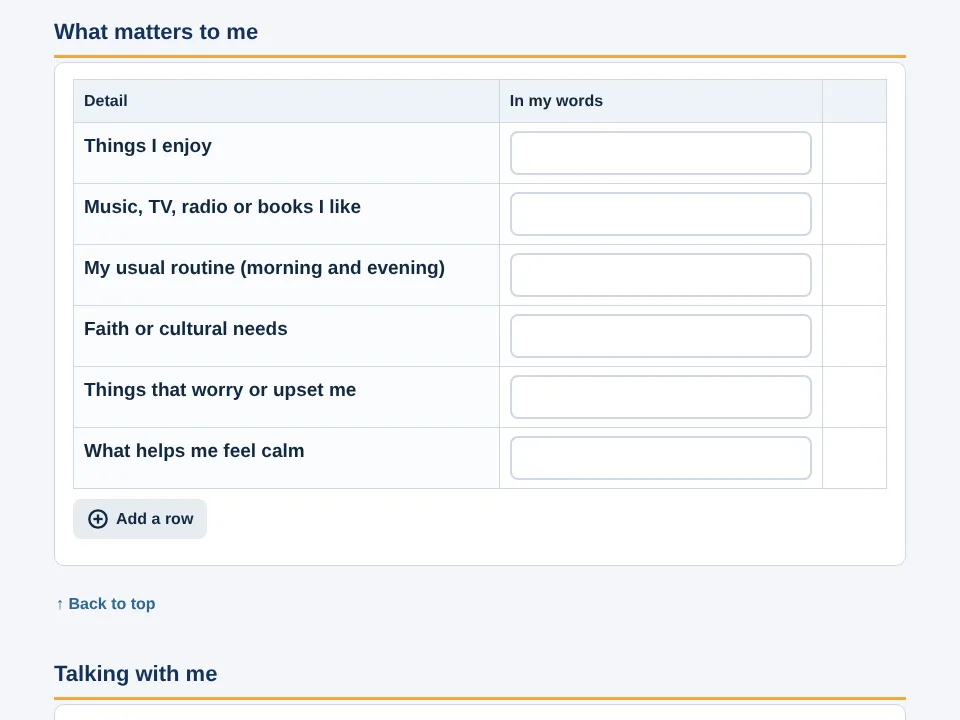
What matters to me
- Things I enjoy
- Music, TV, radio or books I like
- My usual routine (morning and evening)
- Faith or cultural needs
- Things that worry or upset me
- What helps me feel calm
Talking with me
- Hearing (hearing aids, better ear)
- Sight (glasses for reading or distance)
- The best way to talk with me
- How I show I’m in pain or unwell
- Memory: things that help me
Eating and drinking
- Foods I like
- Foods I don’t like
- Special diet (see my medical details for allergies)
- Help I need to eat or drink
- Drinks I like
Washing, dressing and the bathroom
- Bath or shower, and the time of day I prefer
- Help I need with washing and dressing
- Help I need with the bathroom
- Clothes I like to wear
Sleep
- Usual bedtime and wake-up time
- Light, noise and temperature I like
- Naps
- What helps me sleep
Moving around
- Walking aids I use
- Help I need to stand up or move
- Falls in the past, and what helps me feel steady
People to call
A table to fill in, with these columns: Name, Relationship, Phone. Add as many rows as you need.
Need help now?
- Someone in danger, or a medical emergency: call 911.
- Thinking about suicide, or worried about someone: call or text 988, the 988 Suicide & Crisis Lifeline (988 Lifeline (opens in a new tab)).
- Worried an older person is being abused, neglected or exploited: contact your local Adult Protective Services. The Eldercare Locator, 1-800-677-1116, weekdays 9 a.m. to 8 p.m. Eastern, can put you in touch (HHS (opens in a new tab)).
- Lost money or shared details with a scammer: call your bank or card company first, then the National Elder Fraud Hotline, 833-372-8311, Monday to Friday, 10 a.m. to 6 p.m. Eastern (U.S. Department of Justice (opens in a new tab)), or the AARP Fraud Watch Network Helpline, 877-908-3360 (AARP (opens in a new tab)).
- Report a scam: ReportFraud.ftc.gov (opens in a new tab) (Federal Trade Commission), and online crime at ic3.gov (opens in a new tab) (FBI).
General information for readers in the United States, not legal, financial or medical advice. Found a mistake? See our Corrections Policy.
The person, not just the care
A friendly introduction to the person you care for, for a new carer, a respite worker or hospital staff.