
Caregiver answers
How to Help a Parent From a Distance
Living far away doesn't mean you can't help. Many of the jobs that matter most can be done from wherever you are.


Quick answer
From a distance you can handle bills and insurance, order medicines and supplies, arrange in-home help, organize paperwork and help with advance care planning (NIA (opens in a new tab)). Keep a shared list of phone numbers and a shared calendar, join telehealth visits with permission, and support whoever is helping locally (NIA (opens in a new tab)). Your parent can tell their doctors it's all right to talk with you (HHS (opens in a new tab)).
What you can do from afar
The National Institute on Aging lists these as jobs a long-distance caregiver can take on (NIA (opens in a new tab)):
- Help with money matters, paying bills and insurance claims.
- Arrange care management or in-home help.
- Order medical equipment, medicines and supplies.
- Research health conditions and medicines, and keep an eye on insurance benefits.
- Help with advance care planning, such as choosing a health care proxy and preparing a living will.
- Find, organize and update important paperwork and records.
- Research long-term care options, such as assisted living.
Talking with their doctors
Doctors and health plans may share information with family or friends who are involved in a person's care, as long as the person doesn't object. Your parent can simply tell their doctor it's all right to talk with you (HHS (opens in a new tab)). With their permission, you can also join telehealth visits (NIA (opens in a new tab)).
Staying connected
- Keep a shared online list of important phone numbers and email addresses, and update it regularly (NIA (opens in a new tab)).
- Use a shared online calendar to coordinate with everyone helping (NIA (opens in a new tab)).
- Help your parent use texting and video calls (NIA (opens in a new tab)).
Ed's tip, from Stay Safe at Home: Setting up the phone medical IDs and a fridge contact list is a lovely thing to do together, and useful for the whole family. Try: "Let's set up the medical ID on both our phones and put an emergency list on the fridge. If either of us ever can't speak for ourselves, the paramedics will know exactly what they're dealing with."
Making visits count
- Before you go, ask your parent and the local caregiver what they need, then set realistic priorities (NIA (opens in a new tab)).
- Leave time for things that aren't caregiving, such as a movie, a game, music or a drive (NIA (opens in a new tab)).
- Walk through the house together with our free safety checklists.
Supporting the local caregiver
- Ask what you can do that would help most, and stay in regular contact. Just listening can mean a lot (NIA (opens in a new tab)).
- Visit for a few days so they can take a break, or arrange respite through a volunteer, an in-home aide or an adult day program (NIA (opens in a new tab)).
Finding local help
- Eldercare Locator: 800-677-1116, to find your parent's local Area Agency on Aging (NIA (opens in a new tab)).
- Family Caregiver Alliance: 800-445-8106 (NIA (opens in a new tab)).
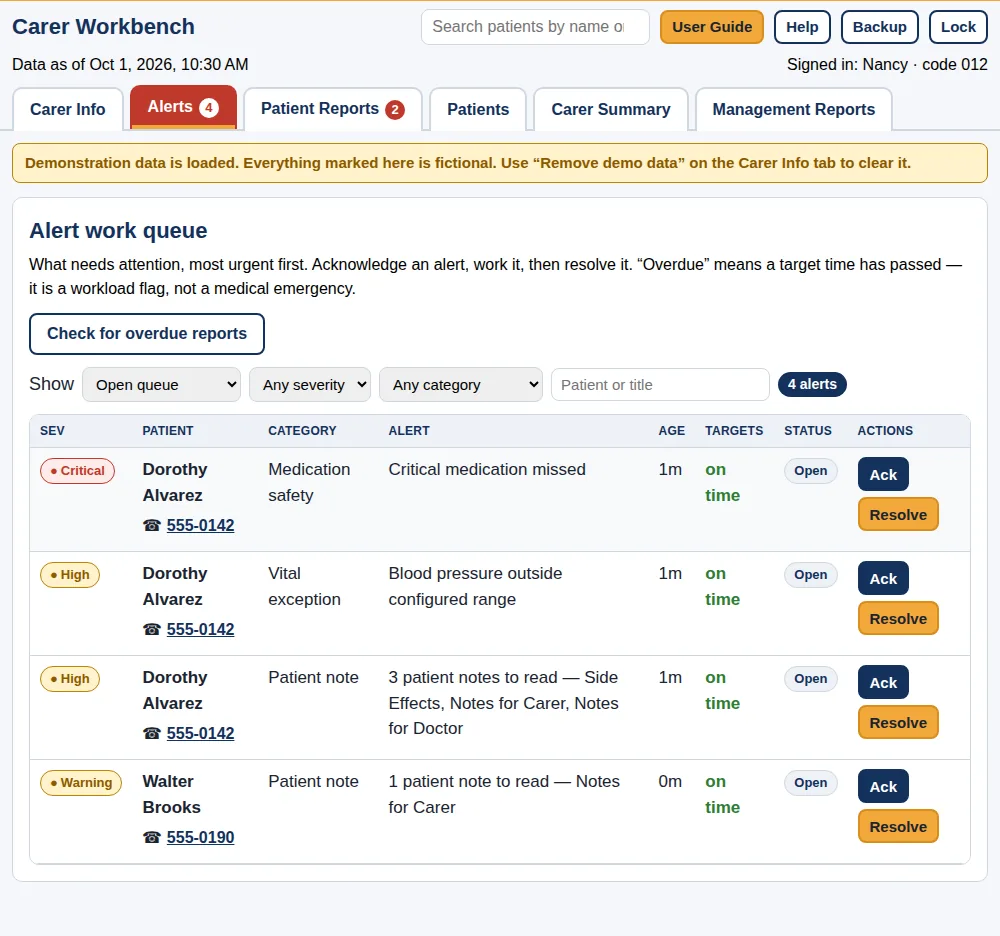
If your parent uses our Health Record, its weekly report can be read in the Carer Workbench, so you can review it from wherever you are.
Questions people ask
Can my parent's doctor talk to me?
Yes, if you're involved in their care and your parent doesn't object. They can tell the doctor it's all right (HHS (opens in a new tab)).
What can I do if I can only visit once or twice a year?
Plenty: bills and insurance, ordering supplies, arranging in-home help, and keeping paperwork organized can all be done from afar (NIA (opens in a new tab)).
Where do I find help near my parent?
Call the Eldercare Locator at 800-677-1116 (NIA (opens in a new tab)).
Need help now?
- Someone in danger, or a medical emergency: call 911.
- Thinking about suicide, or worried about someone: call or text 988, the 988 Suicide & Crisis Lifeline (988 Lifeline (opens in a new tab)).
- Worried an older person is being abused, neglected or exploited: contact your local Adult Protective Services. The Eldercare Locator, 1-800-677-1116, weekdays 9 a.m. to 8 p.m. Eastern, can put you in touch (HHS (opens in a new tab)).
- Lost money or shared details with a scammer: call your bank or card company first, then the National Elder Fraud Hotline, 833-372-8311, Monday to Friday, 10 a.m. to 6 p.m. Eastern (U.S. Department of Justice (opens in a new tab)), or the AARP Fraud Watch Network Helpline, 877-908-3360 (AARP (opens in a new tab)).
- Report a scam: ReportFraud.ftc.gov (opens in a new tab) (Federal Trade Commission), and online crime at ic3.gov (opens in a new tab) (FBI).
Sources
Each source was checked on November 2, 2026 unless a different date is shown.
- What Is Long-Distance Caregiving? National Institute on Aging, reviewed October 12, 2023. https://www.nia.nih.gov/health/long-distance-caregiving/what-long-distance-caregiving (opens in a new tab)
- Family Members and Friends (HIPAA). U.S. Department of Health and Human Services. https://www.hhs.gov/hipaa/for-individuals/family-members-friends/index.html (opens in a new tab)
General information for readers in the United States, not legal, financial or medical advice. This page contains no affiliate links. Found a mistake? See our Corrections Policy.