
Blog · Medication safety
How to Organize Pills So You Don't Mix Them Up
You don't need a perfect memory to take the right pill at the right time. You need a simple system you trust. Here are the ones that work.

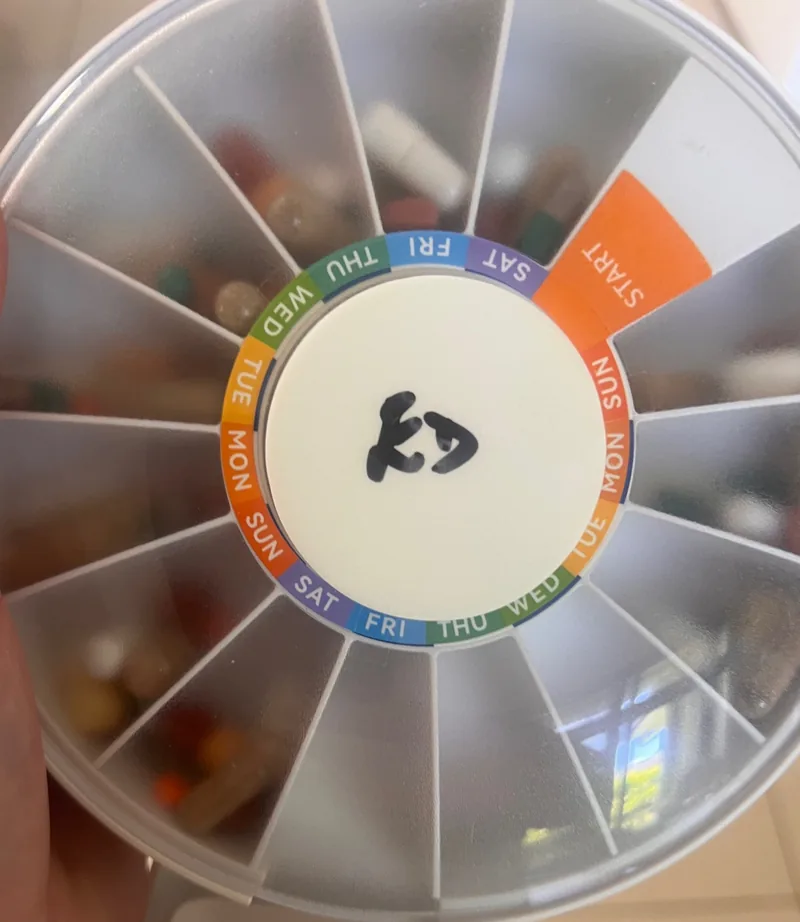
Quick answer
Pick one simple system and stick with it. A weekly pill organizer with a slot for each time of day, filled once a week, works for many people (Mayo Clinic (opens in a new tab)). If filling it yourself is a chore, ask your pharmacy about blister packs, which are sealed and sorted by time of day (ISMP Canada (opens in a new tab)). Keep a written list of everything you take, take medicines in good light, and use one pharmacy if you can (NIA (opens in a new tab)).
Start with one written list
Every good pill system starts on paper. Write down everything you take: prescriptions, over-the-counter medicines, vitamins and supplements. For each one, note the amount and when you take it. For prescriptions, add who prescribed it and why (NIA (opens in a new tab)). Keep one copy at home and one in your wallet or purse (NIA (opens in a new tab)).
A simple medicine record helps too. List each medicine and the time you take it, with a place to check it off once it's done (MedlinePlus (opens in a new tab)). That check mark settles the question "Did I already take it?" Our guide on how to keep a medication list walks you through it.
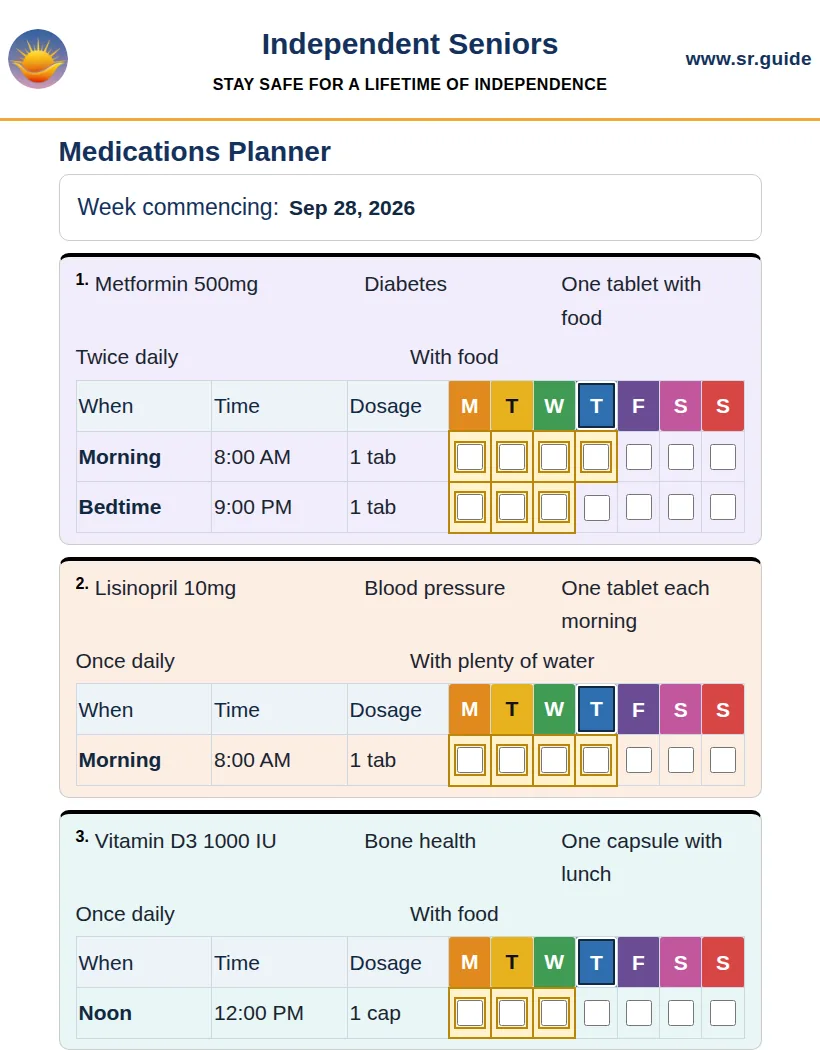
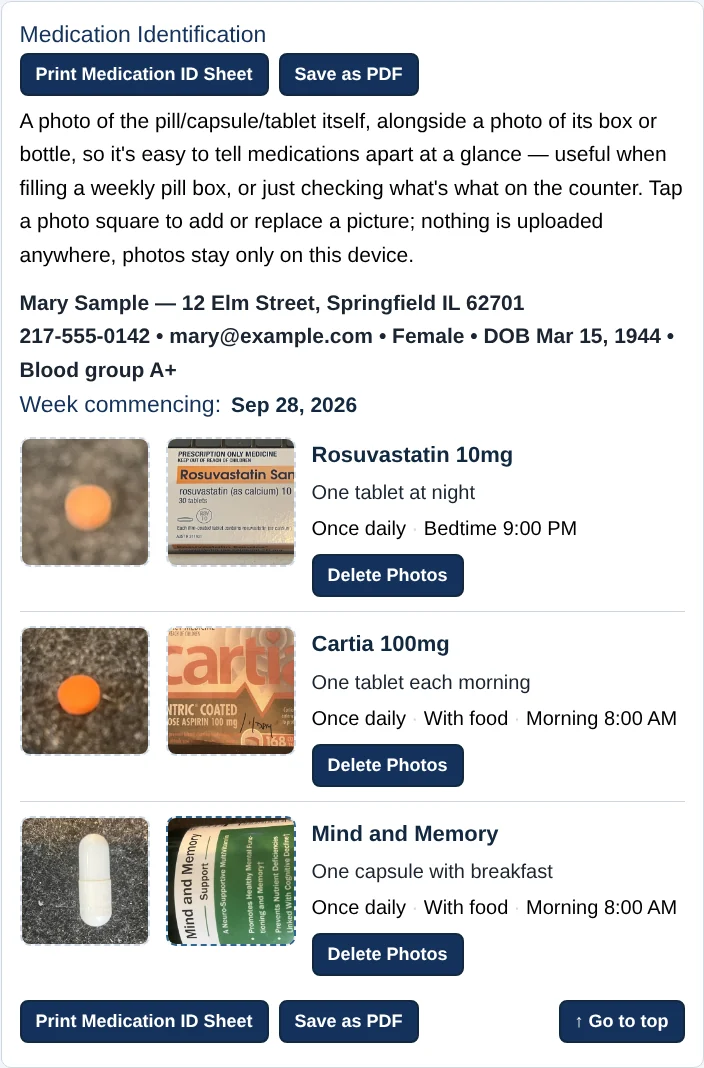
The list and the photo ID are from our Health Record, shown with a fictional person.
Use a weekly pill organizer
A pill organizer is a box with a slot for each day. Some come in 7, 14 or 28 days. Some have up to four compartments a day, for morning, noon, evening and bedtime (MedlinePlus (opens in a new tab)). If you take medicines twice a day, an organizer marked AM and PM keeps the two doses apart. Choose one with as many slots per day as your schedule needs.
Some organizers let you take out one day's pills to carry with you (MedlinePlus (opens in a new tab)). There are also automatic dispensers. They hold 7 to 28 days of pills and use a blinking light and an alarm when a dose is due. You or someone you trust still has to fill them, and they don't let you take pills out early, which can be awkward when you're away from home (MedlinePlus (opens in a new tab)).
One thing to know: most pill organizers are not childproof. Keep yours out of reach of visiting grandchildren (ISMP Canada (opens in a new tab)).
Fill it at one set time
Choose one time each week to fill your organizer, and keep to it. Filling once a week means your doses are ready when it's time, and an empty slot tells you a dose is done (Mayo Clinic (opens in a new tab)). It helps to do it when you won't be rushed.
Gather everything
Set out your list and every medicine you take regularly. Read each pharmacy label so you know when and how to take it (ISMP Canada (opens in a new tab)).
Fill one medicine at a time
Put the right number of tablets or capsules for one medicine into every slot it needs. Finish that medicine before you start the next (ISMP Canada (opens in a new tab)).
Double check
Look over the whole organizer when you're done. If you're unsure, ask a family member or friend to check it with you (ISMP Canada (opens in a new tab)).
Update it after any change
When your doctor, nurse or pharmacist changes a medicine, make the same change in your organizer (ISMP Canada (opens in a new tab)).
If you're an adult child helping a parent, offering to check the organizer together each week is a kind, practical way to help without taking over.
Ask your pharmacy about blister packs
If filling an organizer is hard, ask your pharmacy whether they offer blister packs. These are cards with sealed compartments, one for each time of day you take medicines (ISMP Canada (opens in a new tab)). Your pharmacist prepares and checks them, so you don't sort the pills yourself (ISMP Canada (opens in a new tab)). Some pharmacies sort pills into morning and evening packets instead (Mayo Clinic (opens in a new tab)).
When a pack arrives, check the label, and check one row at a time to make sure everything looks right (ISMP Canada (opens in a new tab)). If your medicines change, take the new prescription and your current pack to the pharmacy (ISMP Canada (opens in a new tab)).
Ed's tip, from Stay Safe at Home: Ask the pharmacy about a blister pack, where they sort your medicines by date and time for you. Using an organizer? Keep the original bottles too.
Keep the original bottles
An organizer is handy, but loose pills can be hard to tell apart. Keep at least one pill of each medicine in its original pharmacy bottle, so anyone checking your organizer can identify it (ISMP Canada (opens in a new tab)). Learn what each of your pills looks like: its size, shape, color and the number printed on it (NIA (opens in a new tab)).
Keep your up-to-date list beside your medicines (ISMP Canada (opens in a new tab)). Save the leaflets that come with each medicine in one easy-to-find file, for as long as you take it (NIA (opens in a new tab)).
Link doses to your daily routine
Habits do a lot of the remembering for you. Some people use meals or bedtime as their cue to take medicine (NIA (opens in a new tab)). You can also set timers, write reminders, or use a medication reminder app on your phone (NIA (opens in a new tab)).
If you find it hard to remember your medicines, or managing many of them feels like too much, tell your doctor. That's worth a call (MedlinePlus (opens in a new tab)).
Good light and one pharmacy
Don't take medicine in the dark, because it's easy to make a mistake (NIA (opens in a new tab)). Fill your organizer and take your doses where the light is good and your glasses are handy. If a label is hard to read, ask your pharmacist to use larger type (NIA (opens in a new tab)).
Try to fill all your prescriptions at the same pharmacy, so your records are in one place. If you use more than one, share your full list with the pharmacist at each (NIA (opens in a new tab)).
Medicines that can't go in an organizer
Not everything fits in a pill box. Some medicines can't be put into blister packs. Examples include inhalers, eye drops, and medicines you take only as needed (ISMP Canada (opens in a new tab)). Keep these in their own labeled containers, and add them to your written schedule so they don't get forgotten.
If you're not sure whether a tablet or capsule is fine to take out of its bottle and keep in an organizer, ask your pharmacist. They can help you choose the best way to organize your medicines (ISMP Canada (opens in a new tab)).
Questions people ask
How often should I fill my pill organizer?
Many people fill it once a week. That way your doses are ready when it's time, and an empty slot tells you a dose is done (Mayo Clinic (opens in a new tab)). Fill one medicine at a time, then double check the whole organizer (ISMP Canada (opens in a new tab)).
Can all my medicines go in a pill organizer?
Not always. Inhalers, eye drops and medicines taken only as needed can't go in blister packs (ISMP Canada (opens in a new tab)). If you're unsure about a particular medicine, ask your pharmacist (ISMP Canada (opens in a new tab)).
What is a blister pack?
It's a card with sealed compartments, each holding the medicines for a particular time of day. Your pharmacist prepares and checks it (ISMP Canada (opens in a new tab)). Ask your pharmacy whether they offer them.
I missed a dose. Should I take two next time?
No. Don't take a double dose. Check with your doctor or pharmacist about what to do for that medicine (MedlinePlus (opens in a new tab)). Our First Aid Guide covers missed and doubled doses.
Need help now?
- Someone has collapsed, has a seizure, has trouble breathing or can't be woken: call 911.
- Took the wrong medicine, or too much: call Poison Help at 1-800-222-1222. It's free and confidential, 24 hours a day (HRSA (opens in a new tab)).
- Thinking about suicide, or worried about someone: call or text 988, the 988 Suicide & Crisis Lifeline (988 Lifeline (opens in a new tab)).
- A question about your own medicines: ask your pharmacist or doctor. This blog is general information, not medical advice.
Sources
Each source was checked in early November 2026 unless a different date is shown.
- Taking Medicines Safely as You Age. National Institute on Aging, reviewed September 22, 2022. https://www.nia.nih.gov/health/medicines-and-medication-management/taking-medicines-safely-you-age (opens in a new tab)
- Keeping your medicines organized. MedlinePlus Medical Encyclopedia, U.S. National Library of Medicine, reviewed July 15, 2026. https://medlineplus.gov/ency/patientinstructions/000600.htm (opens in a new tab)
- Keep Your Medications Organized. SafeMedicationUse.ca newsletter, Institute for Safe Medication Practices Canada, May 29, 2018. https://safemedicationuse.ca/newsletter/organizemeds.html (opens in a new tab)
- Tips to Prevent Medication Errors with Your Blister Pack. SafeMedicationUse.ca newsletter, Institute for Safe Medication Practices Canada, October 21, 2015. https://safemedicationuse.ca/newsletter/newsletter_BlisterPack.html (opens in a new tab)
- Don't miss a dose: Expert advice for managing meds. Mayo Clinic Staff, Mayo Clinic (no publication date shown). https://www.mayoclinic.org/connected-care/dont-miss-a-dose-expert-advice-for-managing-meds/cpt-20528192 (opens in a new tab)
General information for readers in the United States, not medical advice. Always talk with your doctor or pharmacist before you change how you take a medicine. This post contains no affiliate links. Found a mistake? See our Corrections Policy.