
Health answers
How to Keep a Medication List
A medication list helps every doctor, pharmacist and paramedic see what you take, in seconds. Here's what goes on it.

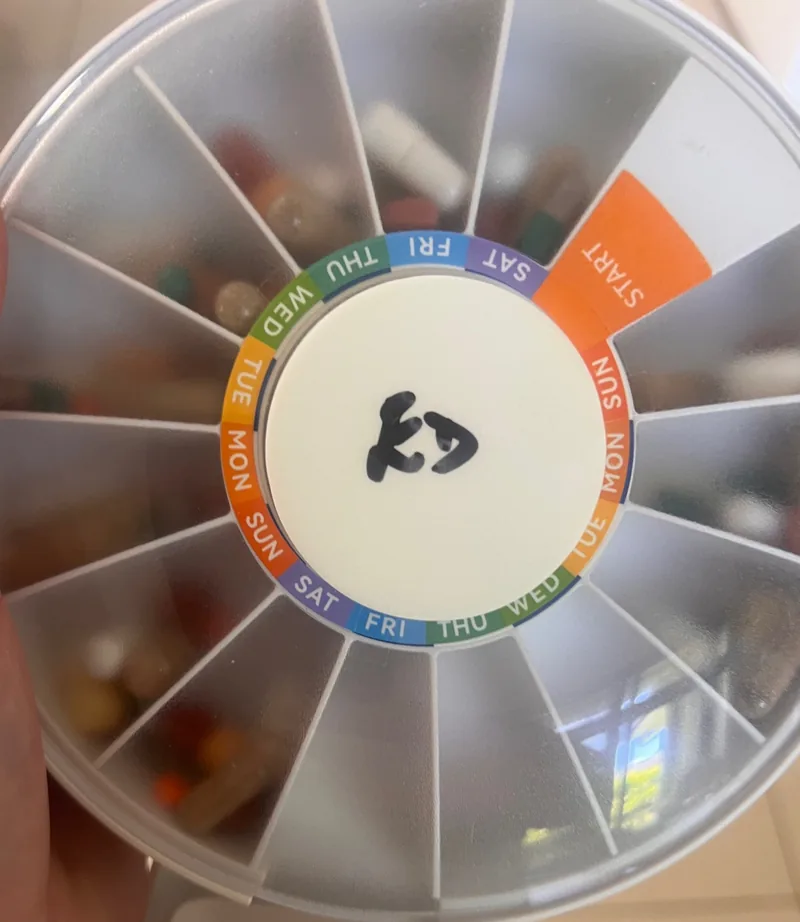
Quick answer
For every prescription, over-the-counter medicine, vitamin and supplement, write down its name, strength, what it's for, and how much you take, when and how. Add your allergies and emergency contacts (FDA (opens in a new tab)). Update it whenever something changes, keep one copy at home and one with you, and show it to every health care provider you see (NIA (opens in a new tab)).
What to include
- The name of each medicine, and its strength (FDA (opens in a new tab)).
- What it's for, and when, how and how much you take (FDA (opens in a new tab)).
- Everything: prescription and nonprescription medicines, vitamins and supplements (FDA (opens in a new tab)).
- Your allergies and your emergency contacts (FDA (opens in a new tab)).
Many people take several medicines. About 1 in 5 Americans used at least five prescription drugs, according to CDC figures quoted by the FDA (FDA (opens in a new tab)).
Keep it up to date
Review and update your list often, especially when you start a new prescription, change a dose or stop a medicine (FDA (opens in a new tab)). At each visit, tell your provider about any new prescriptions, and ask whether you still need all your medicines (NIA (opens in a new tab)).
Ed's tip, from Stay Safe at Home: Ask your doctor for a medication review now and again, especially if the list has grown long. Sometimes things can be cut back, and fewer medicines means fewer chances to slip.
Where to keep it
- One copy in a safe place at home and one in your wallet or purse (NIA (opens in a new tab)).
- A photo on your phone, an app, or a paper copy kept with your health insurance card (FDA (opens in a new tab)).
- A copy on the fridge as part of your emergency information sheet, so paramedics can find it.
Who to share it with
- All your health care providers, including physical therapists and dentists (NIA (opens in a new tab)).
- Your pharmacist. Using one pharmacy keeps your records in one place; if you use more than one, share your list at each (NIA (opens in a new tab)).
- A trusted relative, friend or caregiver, especially anyone who goes to appointments with you or may speak for you in an emergency (FDA (opens in a new tab)).
Ways to keep it
- Paper: the FDA's free printable form, My Medicine Record (FDA (opens in a new tab)).
- Your phone: add your medicines to the Medical ID in your phone (the Health app on an iPhone; Settings, then Safety and emergency, on most Android phones).
- Our Health Record: plan your medicines once, with photos of each pill, and tick off each dose. See Health Record: medications.
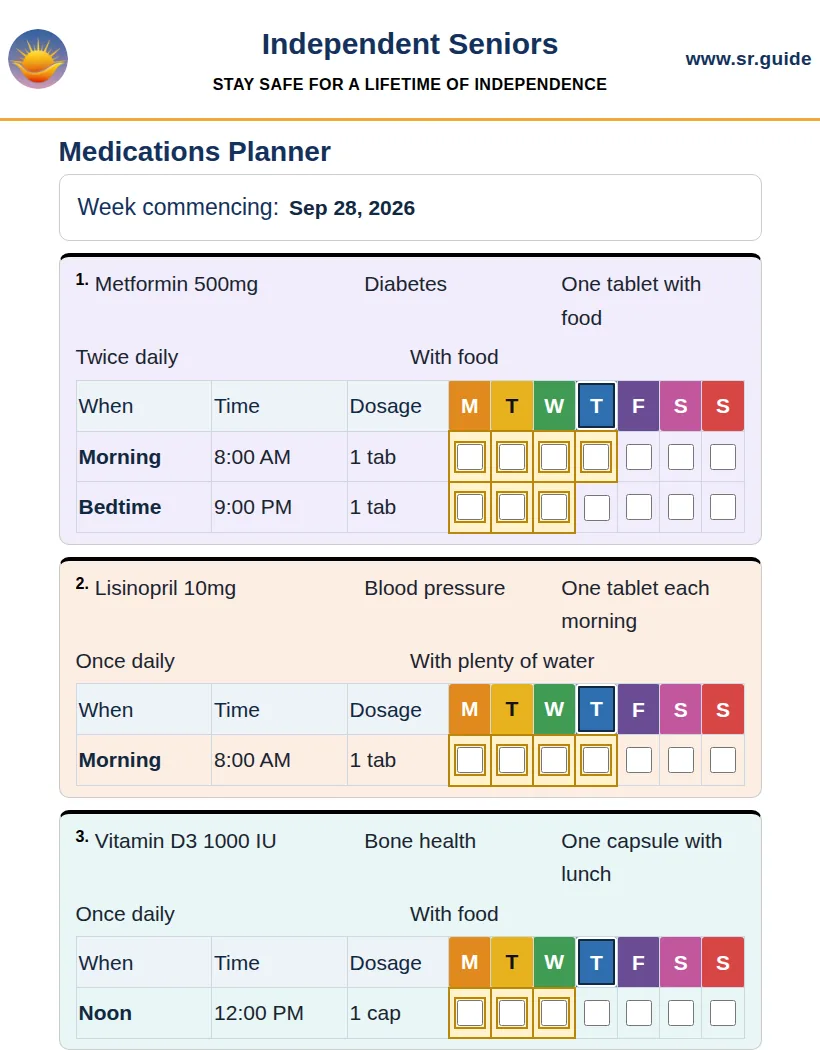
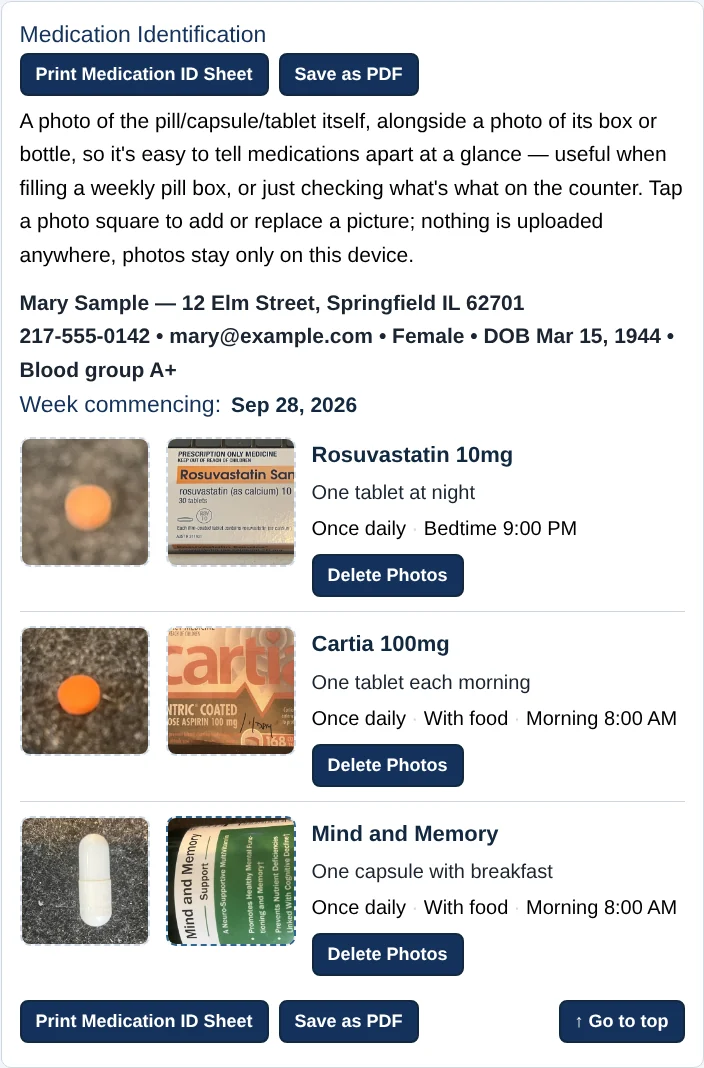
Both are from our Health Record, shown with a fictional person, and both can be printed.
Questions people ask
Do vitamins and supplements belong on the list?
Yes. Include prescription and nonprescription medicines, vitamins and supplements (FDA (opens in a new tab)).
How often should I update it?
Whenever anything changes: a new prescription, a new dose, or a medicine you stop (FDA (opens in a new tab)).
Should I bring it to the dentist?
Yes. Show the list to all your health care providers, including dentists and physical therapists (NIA (opens in a new tab)).
Need help now?
- Someone in danger, or a medical emergency: call 911.
- Thinking about suicide, or worried about someone: call or text 988, the 988 Suicide & Crisis Lifeline (988 Lifeline (opens in a new tab)).
- Worried an older person is being abused, neglected or exploited: contact your local Adult Protective Services. The Eldercare Locator, 1-800-677-1116, weekdays 9 a.m. to 8 p.m. Eastern, can put you in touch (HHS (opens in a new tab)).
- Lost money or shared details with a scammer: call your bank or card company first, then the National Elder Fraud Hotline, 833-372-8311, Monday to Friday, 10 a.m. to 6 p.m. Eastern (U.S. Department of Justice (opens in a new tab)), or the AARP Fraud Watch Network Helpline, 877-908-3360 (AARP (opens in a new tab)).
- Report a scam: ReportFraud.ftc.gov (opens in a new tab) (Federal Trade Commission), and online crime at ic3.gov (opens in a new tab) (FBI).
Sources
Each source was checked on November 2, 2026 unless a different date is shown.
- Create and Keep a Medication List for Your Health. U.S. Food and Drug Administration, current as of January 8, 2025. https://www.fda.gov/consumers/consumer-updates/create-and-keep-medication-list-your-health (opens in a new tab)
- My Medicine Record (printable form). U.S. Food and Drug Administration. https://www.fda.gov/Drugs/ResourcesForYou/ucm079489.htm (opens in a new tab)
- Taking Medicines Safely as You Age. National Institute on Aging, reviewed September 22, 2022. https://www.nia.nih.gov/health/medicines-and-medication-management/taking-medicines-safely-you-age (opens in a new tab)
General information for readers in the United States, not legal, financial or medical advice. This page contains no affiliate links. Found a mistake? See our Corrections Policy.