
Health answers
What to Put on an Emergency Information Sheet
When paramedics arrive, clear information saves precious time. One page, kept where they'll find it, does the job.


Quick answer
Put your medical conditions, allergies, medicines, doctors, insurance details and emergency contacts on one page (American Red Cross (opens in a new tab)). Keep it somewhere obvious, such as the fridge door, carry a copy, and set up the Medical ID on your phone. Review it every six months (American Red Cross (opens in a new tab)).
What to include
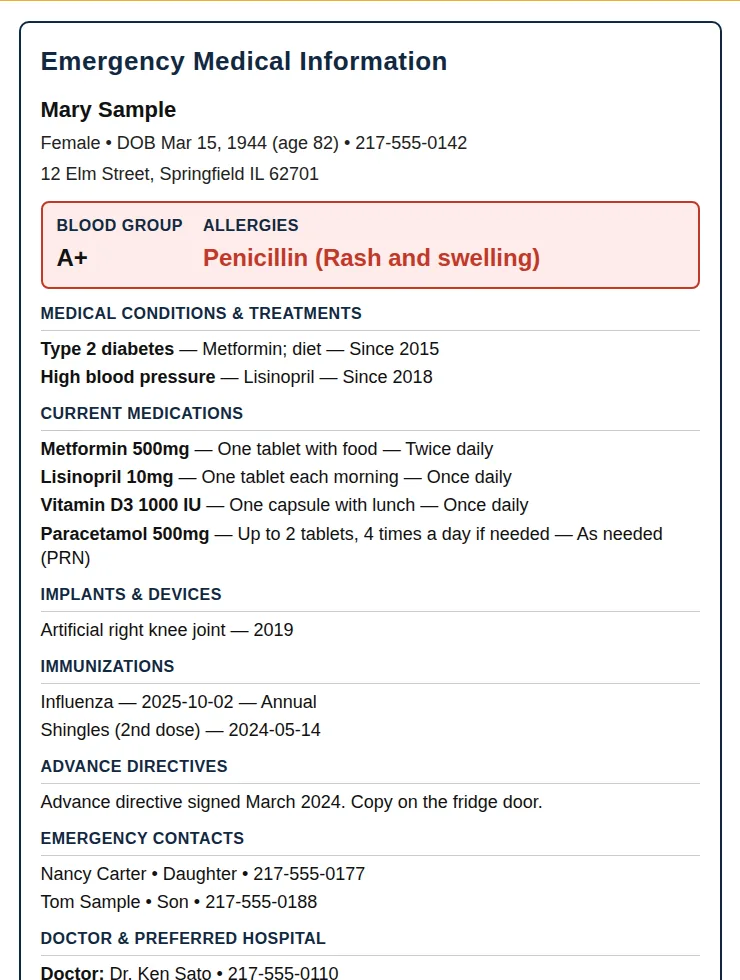
- Your full name and date of birth.
- Your medical conditions and allergies (American Red Cross (opens in a new tab)).
- Your medicines, with doses: see how to keep a medication list (FDA (opens in a new tab)).
- Your doctors, with phone numbers (American Red Cross (opens in a new tab)).
- Your insurance: copies of your Medicare, Medicaid and other insurance cards (Ready.gov (opens in a new tab)).
- Your emergency contacts (American Red Cross (opens in a new tab)).
- Any medical equipment you rely on, such as oxygen or a hearing aid.
Where to keep it
- On the fridge door, or in a clearly labeled folder near the front door, where paramedics will look.
- A copy in your wallet or purse. Our free In Case of Emergency wallet card fits there.
- Tell at least one trusted person where you keep it, along with your emergency supplies (Ready.gov (opens in a new tab)).
On your phone
Ed's tip, from Stay Safe in Any Emergency: Set up your Medical ID and your emergency contacts on your phone today. On an iPhone it is in the Health app; on most Android phones, look in Settings under Safety and emergency. Paramedics can then see your medical conditions, medicines, allergies and who to call, even when your phone is locked. Ten minutes now could make all the difference.
Keep it current
Review your important documents now and every six months (American Red Cross (opens in a new tab)), and update the sheet straight away when a medicine or doctor changes.
Free and ready-made options
- Free: our In Case of Emergency wallet card, to fill in on screen and print. Add it to my Toolkit (opens in a new tab).
- Our Health Record keeps your contacts and health history and prints an Emergency Sheet and wallet card from them. See your details and emergency information.
Questions people ask
Why the fridge?
It's easy to find in an emergency, and everyone in the household knows where it is.
How often should I update it?
Whenever something changes, and check it every six months (American Red Cross (opens in a new tab)).
Should I include my insurance cards?
Yes, keep copies of your Medicare, Medicaid and other insurance cards with it (Ready.gov (opens in a new tab)).
Need help now?
- Someone in danger, or a medical emergency: call 911.
- Thinking about suicide, or worried about someone: call or text 988, the 988 Suicide & Crisis Lifeline (988 Lifeline (opens in a new tab)).
- Worried an older person is being abused, neglected or exploited: contact your local Adult Protective Services. The Eldercare Locator, 1-800-677-1116, weekdays 9 a.m. to 8 p.m. Eastern, can put you in touch (HHS (opens in a new tab)).
- Lost money or shared details with a scammer: call your bank or card company first, then the National Elder Fraud Hotline, 833-372-8311, Monday to Friday, 10 a.m. to 6 p.m. Eastern (U.S. Department of Justice (opens in a new tab)), or the AARP Fraud Watch Network Helpline, 877-908-3360 (AARP (opens in a new tab)).
- Report a scam: ReportFraud.ftc.gov (opens in a new tab) (Federal Trade Commission), and online crime at ic3.gov (opens in a new tab) (FBI).
Sources
Each source was checked on November 2, 2026 unless a different date is shown.
- Older Adults: Emergency Preparedness. American Red Cross. https://www.redcross.org/get-help/how-to-prepare-for-emergencies/older-adults.html (opens in a new tab)
- Older Adults. Ready.gov (FEMA). https://www.ready.gov/older-adults (opens in a new tab)
- Create and Keep a Medication List for Your Health. U.S. Food and Drug Administration, current as of January 8, 2025. https://www.fda.gov/consumers/consumer-updates/create-and-keep-medication-list-your-health (opens in a new tab)
General information for readers in the United States, not legal, financial or medical advice. This page contains no affiliate links. Found a mistake? See our Corrections Policy.