
Free checklist
Fall Risk Self-Check
A free fall risk self-check for seniors and families: fourteen plain questions about your home, your body and health, and your footwear and mobility, with what to do next.

Use it free
This isn't a test, and there's no score. It's a gentle way to notice which areas are worth a closer look, for you or for a parent or loved one you're checking in on.
This page shows the whole checklist so you can read it here. To fill it in on screen, save it and print it, open the interactive version. It's free, with no sign-up.
Open the interactive checklist (opens in a new tab) Add it to my Toolkit (opens in a new tab)
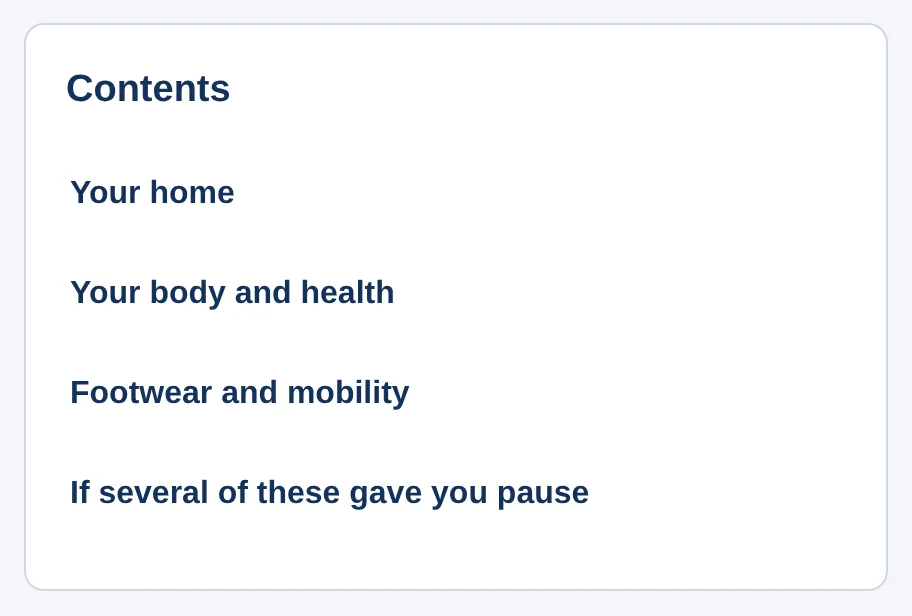
Your home
- Rugs are secured with tape or non-slip pads, or removed
- Walking paths are kept clear of cords, clutter, and shoes
- Every hallway and staircase has a light switch at both ends
- There's a handrail on both sides of any stairs
- Grab bars are fitted in the shower, tub, and beside the toilet
- A light or flashlight is within reach of the bed
Your body and health
- I sit on the edge of the bed for a moment before standing
- I've had my vision checked in the last year
- I know which of my medications can affect balance or make me drowsy
- I feel steady getting up from a low chair or the toilet
- I haven't had a dizzy spell or a near-miss stumble in the last few months
Footwear and mobility
- I wear proper shoes or slippers with grip, not just socks, on stairs and bare floors
- Any cane, walker, or mobility aid I use is the right height and in good repair
- I use my mobility aid consistently, not just "when I remember"
If several of these gave you pause
That's useful information, not a verdict. Bring it up with your doctor at your next visit, or start with one change this week. Often the small ones (a rug, a light, a grab bar) make the biggest difference. Stay Safe at Home covers each of these areas chapter by chapter.
Common questions
What is a fall risk assessment?
A check of the things that make a fall more likely, such as balance, medicines, eyesight, footwear and hazards at home. A full assessment is done by your doctor or a physical therapist; the CDC’s STEADI program (Stopping Elderly Accidents, Deaths & Injuries) gives doctors tools for it (CDC (opens in a new tab)). This self-check is a first look you can do at home. It isn’t an assessment and gives no score.
How common are falls after 65?
More than one in four people aged 65 and older fall each year, but less than half tell their doctor (CDC (opens in a new tab)).
Should I tell my doctor if I’ve fallen?
Yes, even if you weren’t hurt. Your doctor can review your medicines, eyesight and balance, and take this self-check as a starting point for the conversation.
Is the self-check free?
Yes. Fill it in on screen, save it and print it, with no sign-up. Stay Safe at Home covers each area in more depth.
Need help now?
- Someone in danger, or a medical emergency: call 911.
- Thinking about suicide, or worried about someone: call or text 988, the 988 Suicide & Crisis Lifeline (988 Lifeline (opens in a new tab)).
- Worried an older person is being abused, neglected or exploited: contact your local Adult Protective Services. The Eldercare Locator, 1-800-677-1116, weekdays 9 a.m. to 8 p.m. Eastern, can put you in touch (HHS (opens in a new tab)).
- Lost money or shared details with a scammer: call your bank or card company first, then the National Elder Fraud Hotline, 833-372-8311, Monday to Friday, 10 a.m. to 6 p.m. Eastern (U.S. Department of Justice (opens in a new tab)), or the AARP Fraud Watch Network Helpline, 877-908-3360 (AARP (opens in a new tab)).
- Report a scam: ReportFraud.ftc.gov (opens in a new tab) (Federal Trade Commission), and online crime at ic3.gov (opens in a new tab) (FBI).
General information for readers in the United States, not legal, financial or medical advice. Found a mistake? See our Corrections Policy.