
Emergency answers
Do I Need a Medical Alert System? A Plain-English Guide
Buttons, smartwatches and free options: what each one does, what it costs, and how to choose without being sold something you don't need.

Quick answer
A medical alert system lets you call for help by pressing a button you wear on a necklace or bracelet. Some smartwatches do the same (NIA (opens in a new tab)). The monitor alerts emergency help if you fall, get lost or need urgent medical help (NIA (opens in a new tab)).
It's worth considering if you live alone, have fallen before, or have a health condition that could stop you reaching a phone. Two free first steps are carrying a charged phone at all times and setting up a daily check-in with family or a friend (NIA (opens in a new tab)).
Your three main options
| Option | How it works | Good to know |
|---|---|---|
| Phone plus daily check-in | Keep a charged phone with you everywhere and set up a daily call or text with someone (NIA (opens in a new tab)). | Free, but only works if you can reach and use the phone. |
| Wearable alert button | Press a button on a necklace or bracelet to call for help (NIA (opens in a new tab)). Many connect to a monitoring center. | Usually a monthly fee. Ask what's included (see the questions below). |
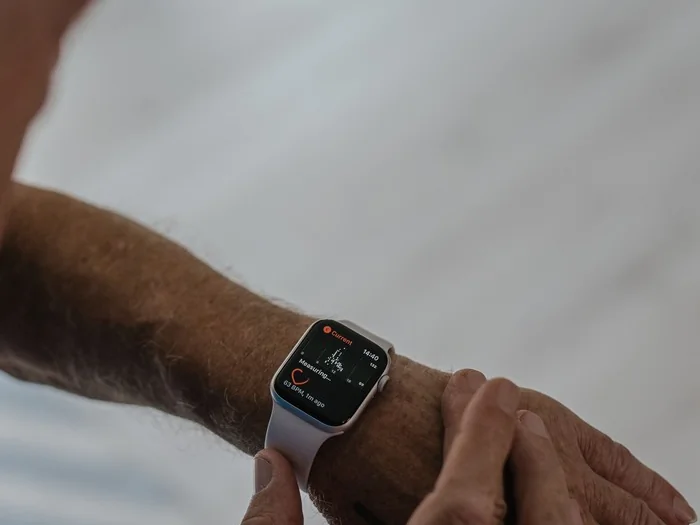
| Smartwatch with fall detection | Can detect a hard fall and call emergency services if you don't respond (Apple (opens in a new tab)). | Needs a cellular, satellite or Wi-Fi connection, and can't detect every fall (Apple (opens in a new tab)). |
How smartwatch fall detection works
Using Apple Watch as an example (Apple Support (opens in a new tab)):
- It works on Apple Watch SE or later, Series 4 or later, and Ultra or later.
- After a hard fall, the watch taps your wrist, sounds an alarm and shows an alert. You can call for help or tap "I'm OK."
- If you don't move for about a minute, it starts a 30-second countdown, then calls emergency services and your emergency contacts automatically.
- Fall Detection turns on automatically if you're 55 or older and entered your age during setup or in the Health app.
- Apple says the watch "cannot detect all falls," so you still need to know how to call for help yourself.
Does Medicare pay for a medical alert?
Original Medicare generally doesn't pay for medical alert systems. Medicare covers durable medical equipment that's used for a medical reason, typically useful only to someone sick or injured, used at home and expected to last at least 3 years (Medicare.gov (opens in a new tab)). Medicare.gov's coverage pages don't list medical alert systems.
Some Medicare Advantage plans may help, and so may some state Medicaid programs that pay for care at home (Medicaid.gov (opens in a new tab)). Ask your plan or your state Medicaid office. Your local Area Agency on Aging can also help: find it through the Eldercare Locator at 1-800-677-1116 (Eldercare Locator (opens in a new tab)).
Beware the "free medical alert" scam
The FTC acted against robocallers who pitched "free" medical alert devices, falsely saying a relative or friend had already paid. People who agreed were then charged activation and monthly monitoring fees (FTC (opens in a new tab)).
If you get a call like this, hang up. Don't press 1 or any other number, because that can lead to more robocalls (FTC (opens in a new tab)). Not sure? Use the 60-second scam check.
10 questions to ask before you buy
These are the ten questions in the latest edition of Stay Safe in Any Emergency. Ask every company the same questions and write down the answers. It makes the offers much easier to compare.
- What's the total cost: the equipment, activation and the monthly monitoring fee?
- Is there a contract? How do I cancel, and is there a fee to cancel?
- Is there a free trial or a money-back period?
- Does it work only at home, or anywhere I go?
- How far from the base unit does the button work in my home and yard?
- Is it waterproof, so I can wear it in the shower?
- Is automatic fall detection included, or does it cost extra?
- Who answers when I press the button, and are they there 24 hours a day?
- What happens next: do they call my family, a neighbor or 911?
- How long does the battery last, and how will I know when it needs charging?
Questions people ask
Will fall detection catch every fall?
No. Apple, for example, says its watch "cannot detect all falls" (Apple Support (opens in a new tab)). Wear the device and practice pressing the button so you can call for help yourself.
What's the difference between a medical alert and a medical ID bracelet?
A medical alert calls for help. A medical ID bracelet or necklace tells responders about your health. If you have a serious allergy or medical need, ask your doctor whether you should wear one (NIA (opens in a new tab)).
Someone called offering me a free medical alert. Is it real?
Be very careful. This is a known scam. Hang up and don't press any numbers (FTC (opens in a new tab)).
Need help now?
- Someone in danger, or a medical emergency: call 911.
- Thinking about suicide, or worried about someone: call or text 988, the 988 Suicide & Crisis Lifeline (988 Lifeline (opens in a new tab)).
- Worried an older person is being abused, neglected or exploited: contact your local Adult Protective Services. The Eldercare Locator, 1-800-677-1116, weekdays 9 a.m. to 8 p.m. Eastern, can put you in touch (HHS (opens in a new tab)).
- Lost money or shared details with a scammer: call your bank or card company first, then the National Elder Fraud Hotline, 833-372-8311, Monday to Friday, 10 a.m. to 6 p.m. Eastern (U.S. Department of Justice (opens in a new tab)), or the AARP Fraud Watch Network Helpline, 877-908-3360 (AARP (opens in a new tab)).
- Report a scam: ReportFraud.ftc.gov (opens in a new tab) (Federal Trade Commission), and online crime at ic3.gov (opens in a new tab) (FBI).
Sources
Each source was checked on October 31, 2026 unless a different date is shown.
- Falls and Fractures in Older Adults: Causes and Prevention. National Institute on Aging. https://www.nia.nih.gov/health/falls-and-falls-prevention/falls-and-fractures-older-adults-causes-and-prevention (opens in a new tab)
- Aging in Place: Growing Older at Home. National Institute on Aging. https://www.nia.nih.gov/health/aging-place/aging-place-growing-older-home (opens in a new tab)
- Use Fall Detection with Apple Watch. Apple Support, May 6, 2026. https://support.apple.com/en-us/108896 (opens in a new tab)
- Durable medical equipment (DME) coverage. Medicare.gov. https://www.medicare.gov/coverage/durable-medical-equipment-dme-coverage (opens in a new tab)
- Home & Community-Based Services 1915(c). Medicaid.gov, checked October 14, 2026. https://www.medicaid.gov/medicaid/home-community-based-services/home-community-based-services-authorities/home-community-based-services-1915c (opens in a new tab)
- Eldercare Locator. Administration for Community Living, checked October 14, 2026. https://eldercare.acl.gov/ (opens in a new tab)
- To robocall scammers who lied about free medical alert devices: We've got your number. Federal Trade Commission (via MilitaryConsumer.gov), January 13, 2014. https://www.militaryconsumer.gov/scam-alerts/robocall-scammers-who-lied-about-free-medical-alert-devices-weve-got-your-number (opens in a new tab)
General information for readers in the United States, not medical advice. Talk with your doctor or pharmacist about your own situation. This page contains no affiliate links. Found a mistake? See our Corrections Policy.