Comes with the Health Record and the Carer Workbench
Appointment Notes
A printable for seniors and carers: questions to ask the doctor, what to bring, notes on what was said, and follow-up actions. Fill it in on screen or print it.

Comes with the Health Record and the Carer Workbench
Questions to ask before a doctor’s visit, notes on what was said, and the follow-up afterwards.
This is a preview: the whole page, so you can see what it covers. To fill it in on screen, save it and print it, it comes with the Health Record and with the Carer Workbench, our everyday tools for seniors and family carers, in a standard and a dyslexia-friendly edition.
Use one copy for each appointment. Write your questions down before you go, take notes while you’re there, and keep track of what happens next. If you use the Health Record, copy the main points into its Daily Notes, under Notes for the doctor.
Before the visit
- Date and time
- Doctor or clinic
- Address and phone
- Reason for the visit
- Who is coming with me
My questions
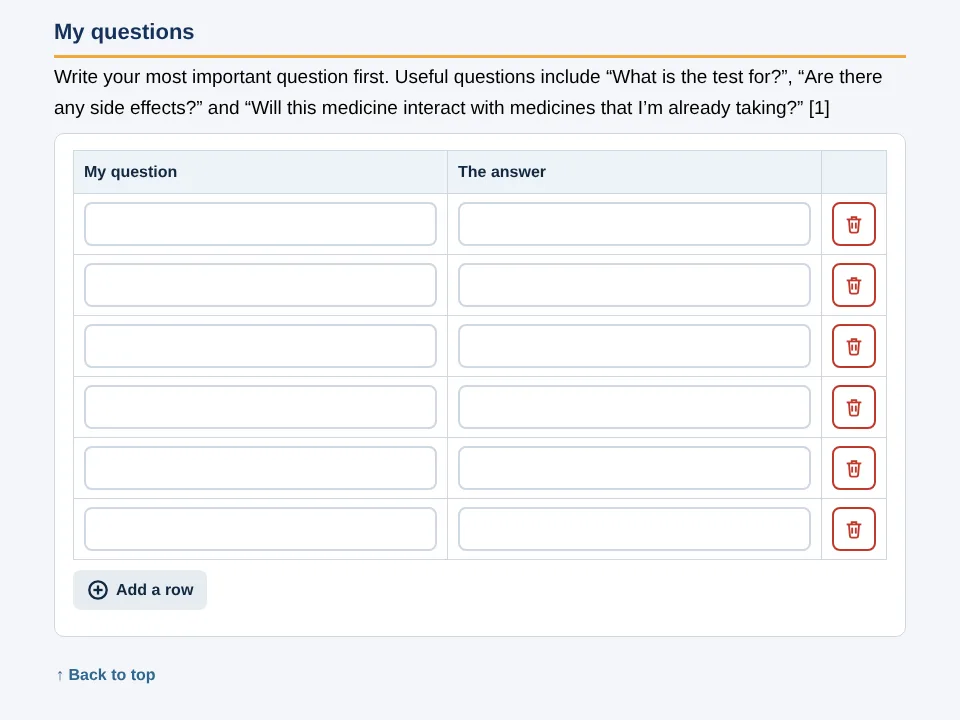
Write your most important question first. Useful questions include “What is the test for?”, “Are there any side effects?” and “Will this medicine interact with medicines that I’m already taking?” [1]
A table to fill in, with these columns: My question, The answer. Add as many rows as you need.
What has changed since my last visit
- New symptoms or problems
- Falls or near-falls
- Medicine changes (including over-the-counter medicines and vitamins)
- Other doctors, hospital or emergency visits
- Readings to show (blood pressure, blood sugar, weight)
What to bring
- My medicine list, or the medicines themselves
- Insurance and Medicare cards, and photo ID
- This sheet and a pen
- Glasses and hearing aids
- My readings or symptom notes
A table to fill in, with these columns: Item, Packed. Add as many rows as you need.
What the doctor said
- The main things to know
- New medicines or changes (name, dose, when to take it)
- Tests ordered, and where
- When and how I’ll get the results
- Referrals to other doctors
- Warning signs to call about
After the visit
The things to do next, and who will do them.
A table to fill in, with these columns: Action, Who, By when, Done. Add as many rows as you need.
Next appointment
- Date and time
- Where
- What to bring
Fact References
Every fact on this page comes from a named source. The numbers in square brackets above match the list below. Links were checked on November 9, 2026.
[1] Agency for Healthcare Research and Quality (AHRQ). "The 10 Questions You Should Know." Questions Are the Answer, reviewed November 2020. https://www.ahrq.gov/questions/10questions.html (opens in a new tab) Accessed November 9, 2026.
Need help now?
- Someone in danger, or a medical emergency: call 911.
- Thinking about suicide, or worried about someone: call or text 988, the 988 Suicide & Crisis Lifeline (988 Lifeline (opens in a new tab)).
- Worried an older person is being abused, neglected or exploited: contact your local Adult Protective Services. The Eldercare Locator, 1-800-677-1116, weekdays 9 a.m. to 8 p.m. Eastern, can put you in touch (HHS (opens in a new tab)).
- Lost money or shared details with a scammer: call your bank or card company first, then the National Elder Fraud Hotline, 833-372-8311, Monday to Friday, 10 a.m. to 6 p.m. Eastern (U.S. Department of Justice (opens in a new tab)), or the AARP Fraud Watch Network Helpline, 877-908-3360 (AARP (opens in a new tab)).
- Report a scam: ReportFraud.ftc.gov (opens in a new tab) (Federal Trade Commission), and online crime at ic3.gov (opens in a new tab) (FBI).
General information for readers in the United States, not legal, financial or medical advice. Found a mistake? See our Corrections Policy.
Ready for the next visit
Questions to ask before a doctor’s visit, notes on what was said, and the follow-up afterwards.