
Health answers
What Is the Best Exercise for Seniors?
There's no single magic exercise. The best one is a mix you enjoy enough to keep doing, and it's easier to start than you might think.

Quick answer
There isn't one best exercise for seniors. The best plan is a mix you'll actually keep doing: aerobic activity such as brisk walking, muscle-strengthening exercises, balance exercises and some stretching (NIA (opens in a new tab)). The CDC's guideline for adults 65 and older is at least 150 minutes of moderate activity a week, muscle-strengthening activities on at least 2 days, and activities that improve balance (CDC (opens in a new tab)). If that's too much right now, start where you are: some physical activity is better than none (CDC (opens in a new tab)).
The honest answer: a mix you'll keep doing
People often ask for the one exercise that matters most. But no single exercise does everything, and the guidance points to a mix.
The National Institute on Aging (NIA) says it's important to get all three main types of exercise: aerobic, muscle-strengthening and balance. It covers stretching for flexibility alongside them (NIA (opens in a new tab)). You may have seen older advice that lists four types: endurance, strength, balance and flexibility. It's the same ground, grouped a little differently.
- Aerobic (endurance) activity is good for your heart, lungs and circulation. Examples include brisk walking, dancing, swimming, bicycling, climbing stairs, and yard work such as raking leaves (NIA (opens in a new tab)).
- Muscle-strengthening exercise helps with everyday tasks and with staying independent. Resistance bands, hand weights, carrying groceries and gardening all count (NIA (opens in a new tab)).
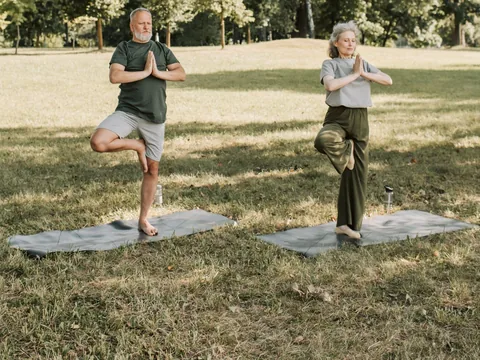
- Balance exercises, such as tai chi, standing on one foot or walking heel to toe, help prevent falls (NIA (opens in a new tab)).
- Stretching can help maintain and improve flexibility. That makes daily jobs easier, such as reaching down to tie your shoes or unloading the dishwasher (NIA (opens in a new tab)).
Some activities cover more than one type at once. NIA names yoga, dancing and water aerobics, and notes that variety helps reduce boredom and the risk of injury (NIA (opens in a new tab)). So my honest answer to "What's the best exercise?" is this: the mix you enjoy enough to keep doing, week after week.
How much exercise do seniors need?
As of November 2026, the CDC's guideline for adults 65 and older has three parts (CDC (opens in a new tab)):
- At least 150 minutes a week of moderate-intensity activity, such as brisk walking. Or 75 minutes of vigorous activity, or a mix of the two.
- At least 2 days a week of activities that strengthen muscles, working all the major muscle groups: legs, hips, back, abdomen, chest, shoulders and arms.
- Activities that improve balance, such as walking heel to toe or standing up from a seated position.
150 minutes sounds like a lot. Broken up, it's about 30 minutes a day, 5 days a week (CDC (opens in a new tab)). NIA adds two practical details. Avoid working the same muscle group on two days in a row, and aim for about three sessions of balance exercises a week (NIA (opens in a new tab)).
How do you know you're at a moderate level? The CDC's simple test: you can talk, but you can't sing the words to your favorite song (CDC (opens in a new tab)).
If you can't meet these numbers, that's all right. The CDC's advice is to be as physically active as your abilities and conditions allow. Some physical activity is better than none at all (CDC (opens in a new tab)).
Walking: the easiest place to start
If you're starting from scratch, walking is hard to beat. You need no equipment. Brisk walking is the CDC's own example of moderate-intensity activity (CDC (opens in a new tab)).
Start with what feels comfortable. NIA's advice is to gradually build up to at least 150 minutes of moderate activity a week, and to do a little easy walking before and after to warm up and cool down (NIA (opens in a new tab)). Everyday walking counts too. The CDC lists walking to the store as aerobic activity (CDC (opens in a new tab)).
Walking counts toward your aerobic minutes. You'll still want some strength and balance work alongside it (NIA (opens in a new tab)). That's where a chair comes in.
Chair exercises when standing is hard
A sturdy chair is one of the most useful pieces of exercise equipment in your home. You can sit and work from it, or hold onto it for support.
A good example is the CDC's chair rise exercise, from its STEADI fall prevention program. It strengthens the muscles in your thighs and buttocks (CDC STEADI (opens in a new tab)). In short:
Sit toward the front of a sturdy chair
Knees bent, feet flat on the floor about shoulder-width apart. Rest your hands lightly on the seat beside you, with your back and neck straight (CDC STEADI (opens in a new tab)).
Lean forward and stand slowly
Breathe in and lean forward, shifting your weight onto the front of your feet. Breathe out and stand up slowly, using your hands as little as possible. Pause for one full breath (CDC STEADI (opens in a new tab)).
Lower yourself slowly
Breathe in as you sit back down slowly. Don't let yourself collapse back into the chair. Then breathe out (CDC STEADI (opens in a new tab)).
The CDC suggests 10 to 15 repetitions, a minute's rest, then a second set. If that's too hard at first, start with fewer and work up. As you get stronger, the goal is to do it without using your hands (CDC STEADI (opens in a new tab)).
Standing up from a seated position also counts as a balance activity in the CDC's guideline (CDC (opens in a new tab)). Our free Daily Chair Fitness and Balance Exercises has ten more gentle activities, mostly seated.
What are balance exercises?
Balance exercises are activities that challenge your steadiness, so your body gets better at staying upright. NIA's examples include (NIA (opens in a new tab)):
- Tai chi and yoga
- Standing on one foot
- Walking heel to toe
- Walking backward or sideways
- Practicing standing up from a sitting position
Strengthening your back, core and leg muscles also improves balance (CDC (opens in a new tab)).
Why they matter: NIA says balance exercises, like muscle-strengthening exercises, help prevent falls and fall-related injuries (NIA (opens in a new tab)). And falls are common. About 1 in 4 adults 65 and older report falling every year, and falls are the leading cause of injury in that age group (CDC (opens in a new tab)).
Practice safely. Have a sturdy chair, a person or a wall nearby to hold onto, and go slowly (NIA (opens in a new tab)).
Ed's tip, from Stay Safe in Any Emergency: Join community or group exercise classes to build confidence and reduce any fear of falling you may have.
What is fall prevention?
Fall prevention is the set of everyday steps that lower your chances of falling. Exercise is one part. The CDC's list for older adults includes (CDC (opens in a new tab)):
- Ask your doctor or health care provider to evaluate your risk for falling.
- Ask your doctor or pharmacist to review your medicines for any that might make you dizzy or sleepy.
- Do exercises that make your legs stronger and improve your balance. Tai chi is a good example.
- Have your eyes checked by an eye doctor at least once a year, and update your glasses if needed.
- Make your home safer: get rid of things you could trip over, and add grab bars, stair railings and better lighting.
The CDC's fall prevention program is called STEADI, short for Stopping Elderly Accidents, Deaths & Injuries. Its free materials for older adults include a home fall prevention checklist and the chair rise exercise above (CDC STEADI (opens in a new tab)). NIA also says to always tell your doctor if you have fallen since your last checkup, even if it didn't hurt (NIA (opens in a new tab)).
This one is personal for me. My friend Phil fell at home, lay alone for six hours and never walked again. Our guide to preventing falls at home covers the rest of the list.
Start slowly and stay safe
If you have a health condition, NIA's advice is to talk with a doctor about it and create a physical activity plan that works for you. NIA also says moderate activities are safe for most people, especially if you build up slowly (NIA (opens in a new tab)). The CDC says people with chronic conditions may want to talk to a health care professional about the types and amounts of activity that suit them (CDC (opens in a new tab)).
A few more safety points from NIA (NIA (opens in a new tab)):
- Listen to your body. Aerobic activity should not cause dizziness, chest pain or pressure, or nausea.
- Talk with your doctor if you're unsure about a particular activity.
- Don't overdo strength work. Too much can cause exhaustion, sore joints, and muscle pain or injury.
- Stretch when your muscles are warmed up, remember to breathe, and don't stretch so far that it hurts.
Everything here is general information. Your own doctor knows your health, so ask them what's right for you.
From Independent Seniors
Try the free Daily Chair Fitness and Balance Exercises
Ten gentle activities, mostly done sitting down, with steps drawn from NIA, CDC, Harvard Health and Cleveland Clinic. It includes the CDC 30-second chair stand test and a week planner to help you work toward 150 minutes.
Questions people ask
What is the number one exercise for seniors?
There isn't one. NIA says it's important to get all three main types of exercise: aerobic, muscle-strengthening and balance, with some stretching for flexibility (NIA (opens in a new tab)). If you want one place to start, brisk walking is the CDC's example of moderate activity and needs no equipment (CDC (opens in a new tab)). Then add strength and balance work.
Is walking enough exercise for seniors?
Walking counts toward the CDC's 150 minutes a week of moderate activity. The CDC also recommends muscle-strengthening activities on at least 2 days a week and activities that improve balance (CDC (opens in a new tab)). A few chair exercises and simple balance moves fill the gap.
What is the best balance exercise for seniors?
No single one. The CDC names tai chi as a good example of exercise that strengthens your legs and improves balance (CDC (opens in a new tab)). NIA also lists standing on one foot, walking heel to toe, walking backward or sideways, and practicing standing up from a sitting position, with a sturdy chair or wall nearby to hold onto (NIA (opens in a new tab)).
Can I get enough exercise sitting in a chair?
A chair is a good place to start, especially if standing for long is hard. The CDC's chair rise exercise strengthens your thighs and buttocks (CDC STEADI (opens in a new tab)). The CDC's advice is to be as physically active as your abilities and conditions allow, because some activity is better than none (CDC (opens in a new tab)).
Should I talk to my doctor before I start exercising?
If you have a health condition, yes. NIA suggests talking with a doctor about your condition and creating a physical activity plan that works for you (NIA (opens in a new tab)), and talking with your doctor if you're unsure about a particular activity (NIA (opens in a new tab)). Also tell your doctor if you have fallen since your last checkup (NIA (opens in a new tab)).
Need help now?
- Someone in danger, or a medical emergency: call 911.
- Thinking about suicide, or worried about someone: call or text 988, the 988 Suicide & Crisis Lifeline (988 Lifeline (opens in a new tab)).
- Worried an older person is being abused, neglected or exploited: contact your local Adult Protective Services. The Eldercare Locator, 1-800-677-1116, weekdays 9 a.m. to 8 p.m. Eastern, can put you in touch (HHS (opens in a new tab)).
- Lost money or shared details with a scammer: call your bank or card company first, then the National Elder Fraud Hotline, 833-372-8311, Monday to Friday, 10 a.m. to 6 p.m. Eastern (U.S. Department of Justice (opens in a new tab)), or the AARP Fraud Watch Network Helpline, 877-908-3360 (AARP (opens in a new tab)).
- Report a scam: ReportFraud.ftc.gov (opens in a new tab) (Federal Trade Commission), and online crime at ic3.gov (opens in a new tab) (FBI).
Sources
Each source was checked in early November 2026 unless a different date is shown.
- Three Types of Exercise Can Improve Your Health and Physical Ability. National Institute on Aging, reviewed January 14, 2025. https://www.nia.nih.gov/health/exercise-and-physical-activity/three-types-exercise-can-improve-your-health-and-physical (opens in a new tab)
- Older Adult Activity: An Overview. Centers for Disease Control and Prevention, December 4, 2025. https://www.cdc.gov/physical-activity-basics/guidelines/older-adults.html (opens in a new tab)
- What Counts as Physical Activity for Older Adults. Centers for Disease Control and Prevention, December 4, 2025. https://www.cdc.gov/physical-activity-basics/adding-older-adults/what-counts.html (opens in a new tab)
- Chair Rise Exercise (STEADI brochure). Centers for Disease Control and Prevention, National Center for Injury Prevention and Control, 2017. https://www.cdc.gov/steadi/pdf/STEADI-Brochure-ChairRiseEx-508.pdf (opens in a new tab)
- Older Adult Falls Data. Centers for Disease Control and Prevention, September 4, 2026. https://www.cdc.gov/falls/data-research/index.html (opens in a new tab)
- Preventing Falls and Hip Fractures. Centers for Disease Control and Prevention, January 27, 2026. https://www.cdc.gov/falls/prevention/index.html (opens in a new tab)
- STEADI Patient and Caregiver Resources. Centers for Disease Control and Prevention, reviewed September 8, 2026. https://www.cdc.gov/steadi/patient-resources/index.html (opens in a new tab)
- Falls and Fractures in Older Adults: Causes and Prevention. National Institute on Aging, reviewed September 12, 2022. https://www.nia.nih.gov/health/falls-and-falls-prevention/falls-and-fractures-older-adults-causes-and-prevention (opens in a new tab)
- Exercising With Chronic Conditions. National Institute on Aging, reviewed January 14, 2025. https://www.nia.nih.gov/health/exercise-and-physical-activity/exercising-chronic-conditions (opens in a new tab)
General information for readers in the United States, not legal, financial or medical advice. This page contains no affiliate links. Found a mistake? See our Corrections Policy.