
Free gentle exercise
Daily Chair Fitness and Balance Exercises
Ten free, gentle activities for strength, flexibility, balance and calm, most done sitting in a sturdy chair, with steps from the National Institute on Aging, the CDC, Harvard Health and Cleveland Clinic.

Use it free
Gentle moves for every day, most of them done sitting in a sturdy chair.
This page describes the ten activities so you can read about them here. To play, open the interactive version. It's free, with no sign-up.
Open it now (opens in a new tab) Add it to my Toolkit (opens in a new tab)
The ten activities
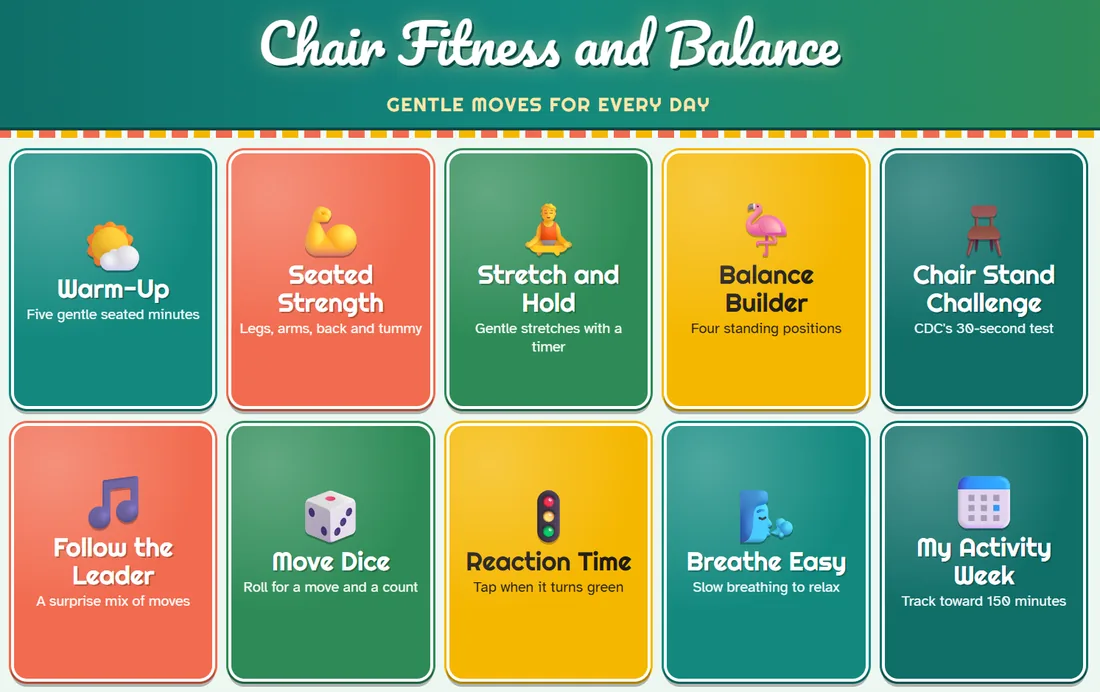
Warm-Up
Five gentle seated minutes.
Seated Strength
Legs, arms, back and tummy.
Stretch and Hold
Gentle stretches with a timer.
Balance Builder
Four standing positions, with the chair to hold.
Chair Stand Challenge
The CDC's 30-second chair stand test.
Follow the Leader
A surprise mix of moves.
Move Dice
Roll for a move and a count.
Reaction Time
Tap when it turns green.
Breathe Easy
Slow breathing to relax.
My Activity Week
Track your week toward 150 minutes.
How it works
- Most activities are done sitting down. For the standing ones, put the chair against a wall and hold on, and have someone nearby if you are unsteady.
- Each activity has a Safety button. Stop if you have pain or pressure in your chest, neck, shoulder or arm, feel dizzy or sick, or have severe joint pain. Call 911 for chest pain, sudden shortness of breath or fainting.
- The CDC recommends that adults 65 and older aim for at least 150 minutes a week of moderate activity, muscle-strengthening on at least 2 days, and activities that improve balance (CDC (opens in a new tab)). My Activity Week adds up your minutes. It is kept only in your own browser.
- If you have a health condition, talk with your doctor about which activities are right for you (National Institute on Aging (opens in a new tab)).
- It's free, with no sign-up, and works on a computer, tablet or phone. Press Menu at any time to go back to the list.
Stay Safe Stay Healthy: Book 7 of the Stay Safe Series, coming soon, covers strength and balance in more depth.
Common questions
Is there a free exercise app for seniors?
Yes. Daily Chair Fitness and Balance Exercises is free, with no sign-up and nothing to install from an app store. It opens in the web browser on your computer, tablet or phone, and you can add it to your free Toolkit.
How much exercise do seniors need each week?
The CDC recommends that adults 65 and older aim for at least 150 minutes a week of moderate activity, such as 30 minutes a day on 5 days, plus muscle-strengthening on at least 2 days and activities that improve balance (CDC (opens in a new tab)). My Activity Week adds up your minutes for you.
Is it safe if I’m unsteady on my feet?
Most activities are done sitting in a sturdy chair. For the standing ones, put the chair against a wall and hold on, and have someone nearby. If you have a health condition, ask your doctor which activities are right for you.
Need help now?
- Someone in danger, or a medical emergency: call 911.
- Thinking about suicide, or worried about someone: call or text 988, the 988 Suicide & Crisis Lifeline (988 Lifeline (opens in a new tab)).
- Worried an older person is being abused, neglected or exploited: contact your local Adult Protective Services. The Eldercare Locator, 1-800-677-1116, weekdays 9 a.m. to 8 p.m. Eastern, can put you in touch (HHS (opens in a new tab)).
- Lost money or shared details with a scammer: call your bank or card company first, then the National Elder Fraud Hotline, 833-372-8311, Monday to Friday, 10 a.m. to 6 p.m. Eastern (U.S. Department of Justice (opens in a new tab)), or the AARP Fraud Watch Network Helpline, 877-908-3360 (AARP (opens in a new tab)).
- Report a scam: ReportFraud.ftc.gov (opens in a new tab) (Federal Trade Commission), and online crime at ic3.gov (opens in a new tab) (FBI).
General information for readers in the United States, not legal, financial or medical advice. Found a mistake? See our Corrections Policy.