
Blog · Medication safety
What Should I Do If I Take the Wrong Medication?
It happens to careful people. Here is what to do, calmly and in order, if you or someone you look after takes the wrong medicine or too much of one.

Quick answer
If the person collapses, has a seizure, has trouble breathing or can't be woken, call 911 (Poison Control (opens in a new tab)). Otherwise, call Poison Help at 1-800-222-1222 or use the webPOISONCONTROL online tool (Poison Control (opens in a new tab)). The call is free and confidential, and help is there 24 hours a day (HRSA (opens in a new tab); MedlinePlus (opens in a new tab)). Don't wait for symptoms, and don't make yourself vomit unless you're told to (MedlinePlus (opens in a new tab)).
First, check whether to call 911
Take a breath. Most medication mistakes are handled over the phone. People usually get the help they need that way, and most don't have to go to a doctor or the hospital (HRSA (opens in a new tab)).
A few signs mean you need emergency help right away. If the person collapses, has a seizure, has trouble breathing or can't be woken, call 911 now (Poison Control (opens in a new tab)). Don't give anything by mouth to someone who is unconscious (MedlinePlus (opens in a new tab)).
Otherwise, call Poison Help: 1-800-222-1222
If none of those signs are there, call Poison Help at 1-800-222-1222. The line connects you to your local poison center. You'll speak with a specially trained nurse, pharmacist or doctor (HRSA (opens in a new tab)).
The call is free and confidential (HRSA (opens in a new tab)). It's open 24 hours a day, 7 days a week, and it doesn't need to be an emergency for you to call (MedlinePlus (opens in a new tab)). Interpretation is available in many languages (HRSA (opens in a new tab)).
Call even if you feel fine. If you think a poisoning has happened, don't wait for symptoms; get help right away (MedlinePlus (opens in a new tab)). You're far from alone in making that call. In 2024, more than 361,000 people called a US poison center for help with a medication error (Poison Control (opens in a new tab)).
Save the number in your phone today, and write it on your emergency information sheet, so nobody has to hunt for it.
Ed's tip, from Stay Safe at Home: If it's a medication problem, too much of your own medicine, the wrong pill, or someone else's prescription taken by mistake, call Poison Help at 1-800-222-1222 right away if the person is alert. Have the bottle in hand if you can. If they're collapsed, struggling to breathe, or unconscious, call 911 instead.
Have the bottle ready
Keep the medicine container in your hand when you call, if you can (MedlinePlus (opens in a new tab)). The poison center will want to know (Poison Control (opens in a new tab)):
- The name of the medicine
- How much was taken
- When it was taken
- The person's age
- The person's weight
If you're calling, they'll also ask for your name and phone number (Poison Control (opens in a new tab)). If the pill belonged to someone else, have that person's bottle in hand, since that's the medicine they need to know about.
What not to do
- Don't make yourself vomit unless the poison center or a health care provider tells you to (MedlinePlus (opens in a new tab)).
- Don't wait for symptoms before getting help (MedlinePlus (opens in a new tab)).
- Don't try home remedies such as lemon juice or vinegar to "neutralize" anything, unless you're told to (MedlinePlus (opens in a new tab)).
Then follow the advice you're given. Most people can stay at home (HRSA (opens in a new tab)). If you are told to go to the hospital, take the medicine container with you (MedlinePlus (opens in a new tab)).
Prefer to type? Use the online tool
Poison Control runs a free online tool called webPOISONCONTROL. You answer simple questions about what happened, and you get a recommendation in less than 3 minutes (Poison Control (opens in a new tab)). It's especially useful for double doses (Poison Control (opens in a new tab)). It also comes as an app for Apple and Android phones (Poison Control (opens in a new tab)).
Both the online tool and the phone line are free, expert and confidential (Poison Control (opens in a new tab)). If you'd rather talk to a person, pick up the phone. That's what they're there for.
Afterward: tell your doctor and prevent a repeat
Once things are settled, let your doctor or pharmacist know what happened. Poison Control suggests talking with your pharmacist and primary health care provider about a system for keeping track of your medicines (Poison Control (opens in a new tab)).
A few habits go a long way:
- Check the label every time, turn on the light, and wear your glasses if you need them (Poison Control (opens in a new tab)).
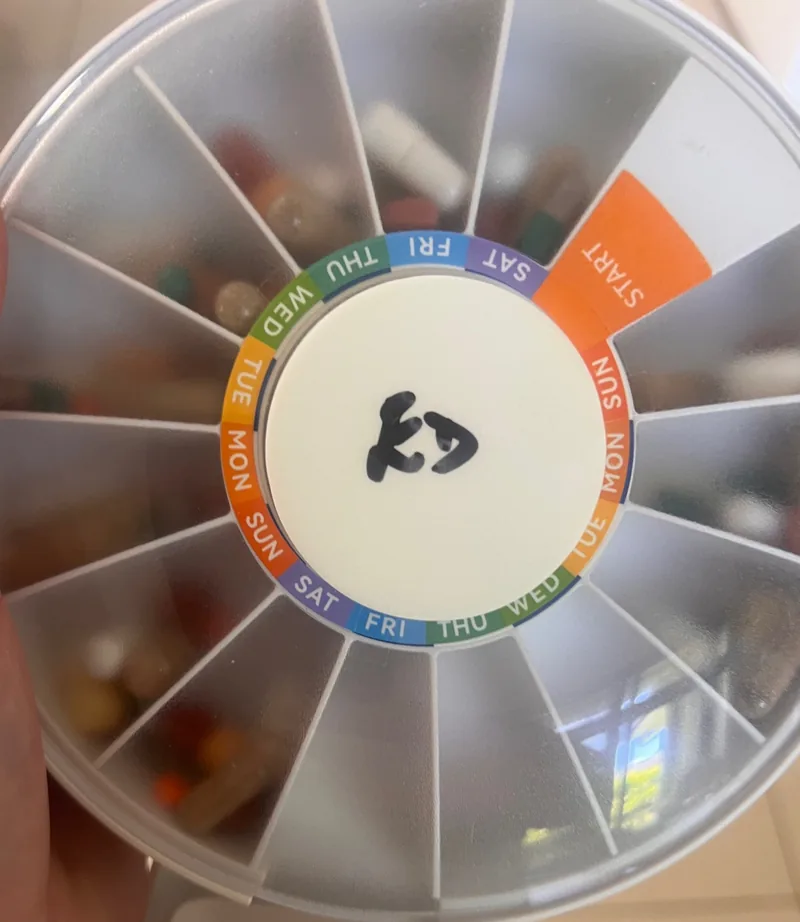
- Use a pill organizer, and keep a log you mark each time you take a dose (Poison Control (opens in a new tab)).
- Set an alarm for once-a-day medicines (Poison Control (opens in a new tab)).
- Store each person's medicines in a different cabinet or small box (Poison Control (opens in a new tab)).
- Take only your own medicine (Poison Control (opens in a new tab)).
If you help a parent with their medicines, go over these steps together now, while all is calm. Make sure they know where the number is. HRSA suggests caregivers set up a daily routine with reminders or timers, and get prescriptions refilled early to avoid running out (HRSA (opens in a new tab)). It also suggests telling all of your parent's health care professionals about every medicine they take, especially before a new prescription (HRSA (opens in a new tab)).
There's more in our post on how to prevent medication mistakes at home.
This is general information, not medical advice. Your doctor, your pharmacist and the poison center are the right people to ask about your own situation.
Questions people ask
I took a double dose but I feel fine. Should I still call?
Yes. Don't wait for symptoms before getting help (MedlinePlus (opens in a new tab)). Call 1-800-222-1222, or use webPOISONCONTROL, which Poison Control says is especially useful for double doses (Poison Control (opens in a new tab)).
Does it cost anything to call Poison Help?
No. The call is free and confidential, and you'll speak with a specially trained nurse, pharmacist or doctor at your local poison center (HRSA (opens in a new tab)).
Is Poison Help only for children?
No. HRSA's guide for older adults and caregivers says to call Poison Help if a medicine wasn't taken as directed, or too much was taken by accident (HRSA (opens in a new tab)).
Will I have to go to the hospital?
Usually not. People usually get the help they need over the phone, and most don't have to go to a doctor or the hospital (HRSA (opens in a new tab)). Follow the advice the poison center gives you.
Should I make myself throw up?
No, not unless the poison center or a health care provider tells you to (MedlinePlus (opens in a new tab)).
Need help now?
- Someone has collapsed, has a seizure, has trouble breathing or can't be woken: call 911.
- Took the wrong medicine, or too much: call Poison Help at 1-800-222-1222. It's free and confidential, 24 hours a day (HRSA (opens in a new tab)).
- Thinking about suicide, or worried about someone: call or text 988, the 988 Suicide & Crisis Lifeline (988 Lifeline (opens in a new tab)).
- A question about your own medicines: ask your pharmacist or doctor. This blog is general information, not medical advice.
Sources
Each source was checked in early November 2026 unless a different date is shown.
- Poison Control home page (webPOISONCONTROL online tool and 1-800-222-1222). National Capital Poison Center, accessed November 2026. https://www.poison.org/ (opens in a new tab)
- About Us: Poison Help. Health Resources and Services Administration (HRSA), last updated January 8, 2025. https://poisonhelp.hrsa.gov/about-us (opens in a new tab)
- Poisoning First Aid. MedlinePlus Medical Encyclopedia, National Library of Medicine, reviewed January 8, 2025. https://medlineplus.gov/ency/article/007579.htm (opens in a new tab)
- Medication Errors: What to Know. Poison Control, National Capital Poison Center, accessed November 2026. https://www.poison.org/articles/medication-errors (opens in a new tab)
- Double Dosing: What to Do If You Take Too Much. Poison Control, National Capital Poison Center, accessed November 2026. https://www.poison.org/articles/medication-errors-double-dosing (opens in a new tab)
- Medications Can Get Confusing! Poison Control, National Capital Poison Center, accessed November 2026. https://www.poison.org/articles/medications-can-get-confusing (opens in a new tab)
- Safe Medicine Use & Poison Prevention Tips: A Guide for Older Adults and Caregivers. Poison Help, Health Resources and Services Administration (HRSA), March 2019. https://poisonhelp.hrsa.gov/sites/default/files/poisonhelp/resources/brochure_safe-medicine-tips.pdf (opens in a new tab)
General information for readers in the United States, not medical advice. Always talk with your doctor or pharmacist before you change how you take a medicine. This post contains no affiliate links. Found a mistake? See our Corrections Policy.