
Blog · Medication safety
How Can I Prevent Medication Mistakes at Home?
Most medication mix-ups at home come down to a few small slips. A few steady habits catch nearly all of them, and none of them are hard.

Quick answer
Keep one current list of everything you take, fill your prescriptions at one pharmacy, and check the label every time you take a dose (NIA (opens in a new tab)). Take medicines in good light with your glasses on, and take only your own (Poison Control (opens in a new tab)). Keep medicines in their original labeled containers, and review them with your doctor or pharmacist at least once a year (HRSA (opens in a new tab)).
Keep one list of everything you take
One current list is the backbone of medication safety. Write down every medicine you take, including the over-the-counter ones (NIA (opens in a new tab)). Add vitamins and supplements too. For each one, note the dose, when you take it, who prescribed it and what it's for (NIA (opens in a new tab)).
Show the list to all your health care providers, including your dentist (NIA (opens in a new tab)). Bring it to every doctor's appointment (HRSA (opens in a new tab)). Keep a copy with you, and update it whenever something changes (ISMP (opens in a new tab)).
If you'd like help getting started, our guide on how to keep a medication list walks you through it.
Use one pharmacy, and check before you leave
Try to fill all your prescriptions at the same pharmacy. That way your records are in one place (NIA (opens in a new tab)).
Check the label before you leave the pharmacy. It should have your name on it and the directions your doctor gave you. If it doesn't, don't take it, and talk with the pharmacist (NIA (opens in a new tab)).
Small print is a real problem for many of us. Ask your pharmacist to use larger type on your labels (NIA (opens in a new tab)). You can also ask whether they can print your prescription labels in large print (HRSA (opens in a new tab)).
Read the label every time, in good light
Check the label every time you take a medicine. The goal is simple: the right medicine, at the right time, in the right amount (Poison Control (opens in a new tab)). Make sure the label is for you, too (HRSA (opens in a new tab)). That matters most when more than one person in the house takes medicine.
Don't take medicine in the dark (NIA (opens in a new tab)). Turn on the light. If you need glasses, wear them (Poison Control (opens in a new tab)).
Ed's tip, from Stay Safe at Home: Take them in good light, where you can read the label and see the pill. A lot of mix-ups happen in the gloom or without the glasses on.
Keep the original bottles, even with a pill box
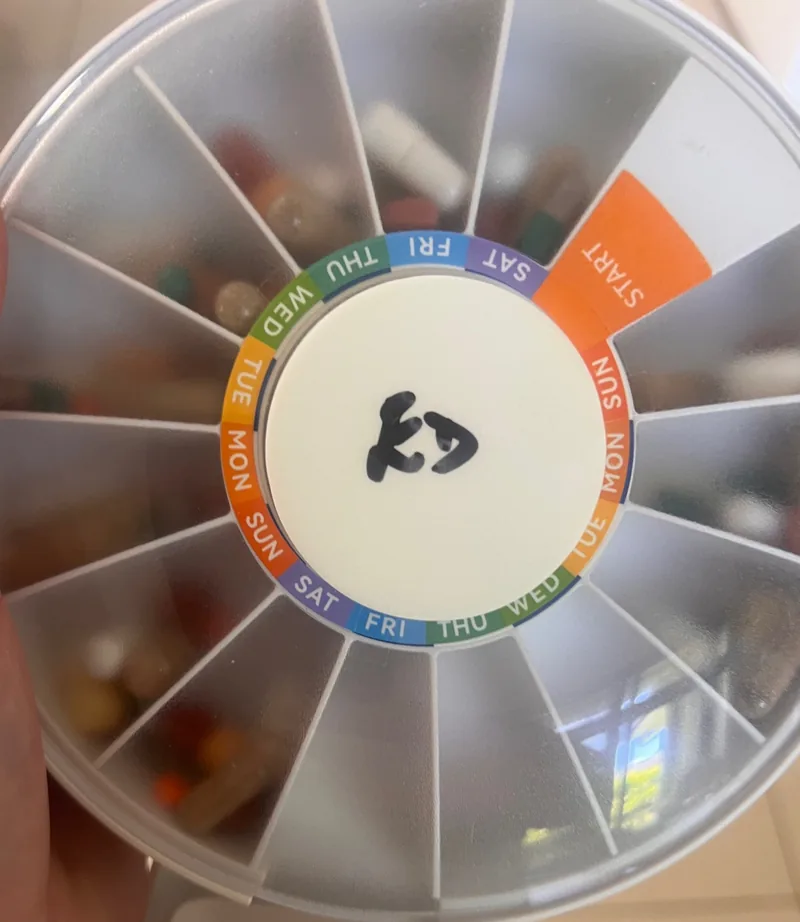
Plenty of people use a weekly pill box, a chart or a calendar to keep track (NIA (opens in a new tab)). A pill box with compartments for each day of the week and time of day keeps each dose in its place (Poison Control (opens in a new tab)). A written log works well too: mark it each time you take a dose (Poison Control (opens in a new tab)).
Keep your medicines in their original containers as well (ISMP (opens in a new tab)). Many medicines look alike, and the labeled bottle is how you know which is which (ISMP (opens in a new tab)). Never mix different tablets or capsules in one container (ISMP (opens in a new tab)). HRSA's guide for older adults puts it this way: it's best to keep all medicines in their original labeled containers, and to be careful when you use a pill box (HRSA (opens in a new tab)). So fill the pill box from the bottles, and keep the bottles.
Where you keep them matters too. Keep medicines out of heat and direct sunlight, and out of reach of children and pets (NIA (opens in a new tab)). Don't store them in the bathroom medicine cabinet (ISMP (opens in a new tab)). Keep them apart from other household products, and keep pet medicines separate from yours, so nothing gets confused (ISMP (opens in a new tab)).
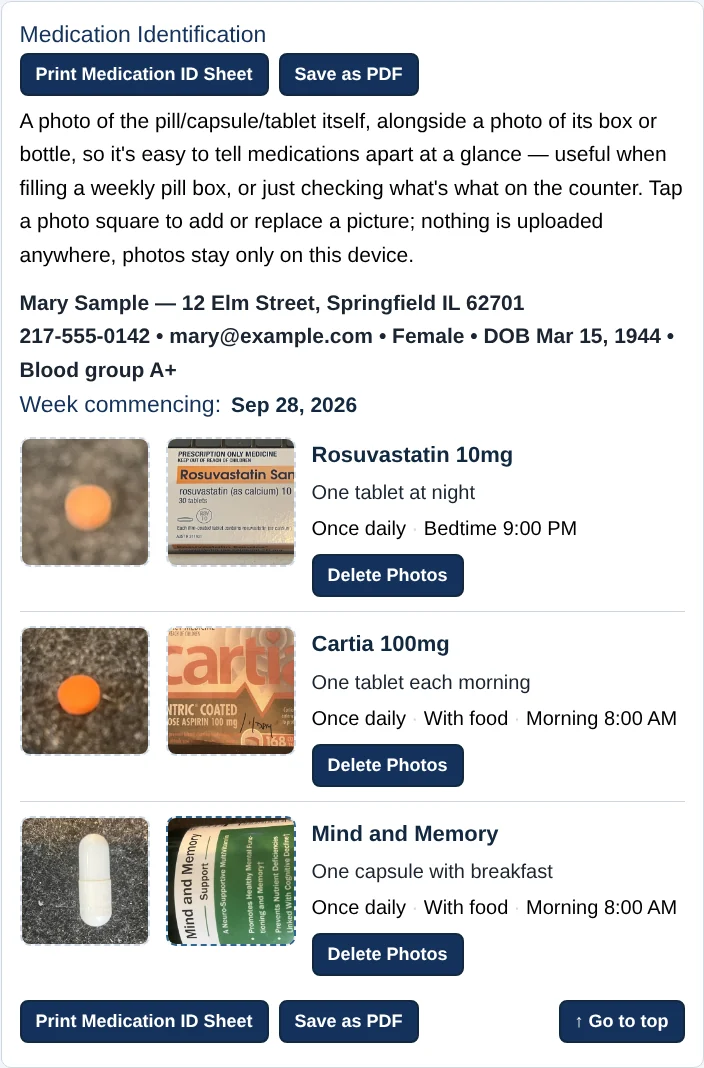
For more ideas, see how to organize your pills. If you prefer something on screen, our Health Record lets you plan your medicines once, with a photo of each pill, and tick off each dose as you take it.
Watch for doubled-up ingredients
Over-the-counter medicines can cause mix-ups too. Read the Drug Facts label, especially the Active Ingredients section (HRSA (opens in a new tab)). Avoid taking two medicines that contain the same ingredient (Poison Control (opens in a new tab)). Taking too much of one ingredient can cause harm (HRSA (opens in a new tab)).
Not sure what's safe alongside your prescriptions? Ask your pharmacist or doctor which over-the-counter medicines to avoid (HRSA (opens in a new tab)).
Never share medicines
Don't take medicines prescribed for someone else, and don't give yours to anyone (NIA (opens in a new tab)). A medicine should only be used by the person it was prescribed for (HRSA (opens in a new tab)).
If two of you in the house take medicines, store each person's in a different cabinet or a small box of their own (Poison Control (opens in a new tab)). Then a quick reach in the morning can't land on the wrong bottle.
Ask before you start anything new
Before you start a new medicine, your doctor or pharmacist can give you important information and answer your questions (NIA (opens in a new tab)). Talk with your health care provider before starting any new prescription, over-the-counter medicine or supplement (NIA (opens in a new tab)).
Know why you take each of your medicines (HRSA (opens in a new tab)). Review them all with your doctor or pharmacist at least once a year, and whenever you start something new (HRSA (opens in a new tab)). And never take more than prescribed, thinking it will help more (NIA (opens in a new tab)).
Helping a parent? HRSA suggests a daily routine with reminders or timers, large-print labels, and asking providers to speak slowly and write key information down (HRSA (opens in a new tab)). Get prescriptions refilled early, so your parent doesn't run out (HRSA (opens in a new tab)).
If a mistake happens anyway
Even careful people slip up now and then. If a medicine wasn't taken as directed, or too much was taken by accident, call Poison Help at 1-800-222-1222. The call is free, and help is there 24 hours a day, 7 days a week (HRSA (opens in a new tab)). If someone has trouble breathing, trouble waking up or a seizure, call 911 (HRSA (opens in a new tab)).
Our post on what to do if you take the wrong medication goes through it calmly, step by step.
This is general information, not medical advice. Your doctor and pharmacist know your medicines, and they're the right people to ask about your own.
Questions people ask
Is it OK to put my pills in a weekly pill box?
Many people use one (NIA (opens in a new tab)). HRSA says it's best to keep medicines in their original labeled containers and to be careful with a pill box (HRSA (opens in a new tab)). Fill the box from the bottles, and keep the bottles so you can always check which pill is which (ISMP (opens in a new tab)).
The print on my pill bottle is too small. What can I do?
Ask your pharmacist to use larger type (NIA (opens in a new tab)). You can also ask whether they can print your prescription labels in large print (HRSA (opens in a new tab)).
My husband and I take the same medicine. Can we share a bottle?
It's safest not to. Take only your own medicine (Poison Control (opens in a new tab)), and keep each person's medicines in a separate cabinet or box (Poison Control (opens in a new tab)).
How often should my medicines be reviewed?
HRSA suggests reviewing all your medicines with your doctor or pharmacist at least once a year, and whenever you start a new one (HRSA (opens in a new tab)). Bring your full list, including vitamins and supplements.
Where should I keep my medicines?
Somewhere away from heat and direct sunlight, and out of reach of children and pets (NIA (opens in a new tab)). ISMP advises against the bathroom medicine cabinet (ISMP (opens in a new tab)). Ask your pharmacist if any of your medicines need special storage (NIA (opens in a new tab)).
Need help now?
- Someone has collapsed, has a seizure, has trouble breathing or can't be woken: call 911.
- Took the wrong medicine, or too much: call Poison Help at 1-800-222-1222. It's free and confidential, 24 hours a day (HRSA (opens in a new tab)).
- Thinking about suicide, or worried about someone: call or text 988, the 988 Suicide & Crisis Lifeline (988 Lifeline (opens in a new tab)).
- A question about your own medicines: ask your pharmacist or doctor. This blog is general information, not medical advice.
Sources
Each source was checked in early November 2026 unless a different date is shown.
- Taking Medicines Safely as You Age. National Institute on Aging, reviewed September 22, 2022. https://www.nia.nih.gov/health/medicines-and-medication-management/taking-medicines-safely-you-age (opens in a new tab)
- Safe Medicine Use & Poison Prevention Tips: A Guide for Older Adults and Caregivers. Poison Help, Health Resources and Services Administration (HRSA), March 2019. https://poisonhelp.hrsa.gov/sites/default/files/poisonhelp/resources/brochure_safe-medicine-tips.pdf (opens in a new tab)
- Medications at Home. ConsumerMedSafety.org, Institute for Safe Medication Practices (ISMP), accessed November 2026. https://www.consumermedsafety.org/safety-tips/medications-at-home (opens in a new tab)
- Medications Can Get Confusing! Poison Control, National Capital Poison Center, accessed November 2026. https://www.poison.org/articles/medications-can-get-confusing (opens in a new tab)
- Medication Errors: What to Know. Poison Control, National Capital Poison Center, accessed November 2026. https://www.poison.org/articles/medication-errors (opens in a new tab)
- Double Dosing: What to Do If You Take Too Much. Poison Control, National Capital Poison Center, accessed November 2026. https://www.poison.org/articles/medication-errors-double-dosing (opens in a new tab)
General information for readers in the United States, not medical advice. Always talk with your doctor or pharmacist before you change how you take a medicine. This post contains no affiliate links. Found a mistake? See our Corrections Policy.