
Comes with the Health Record and the Carer Workbench
Going Into Hospital Checklist
A checklist for seniors and family carers: what to pack for a hospital stay, what to ask, and how to plan the return home, following Medicare’s discharge checklist.

Comes with the Health Record and the Carer Workbench
What to pack, what to ask while you’re there, and how to plan a safe return home.
This is a preview: the whole page, so you can see what it covers. To fill it in on screen, save it and print it, it comes with the Health Record and with the Carer Workbench, our everyday tools for seniors and family carers, in a standard and a dyslexia-friendly edition.
For a planned hospital stay, or to keep ready in case of an unplanned one. Mark each item OK when it’s done or doesn’t apply, or Action if it still needs doing. The planning-to-go-home steps follow Medicare’s own discharge checklist [1].
What to pack
- My medicine list, with doses (bring the medicines too if the hospital asks)
- Insurance and Medicare cards, and photo ID
- A list of my doctors and emergency contacts
- A copy of my advance directive or health care proxy, if I have one
- Glasses, hearing aids and dentures, with their cases, labeled with my name
- Phone and charger, with a long cable
- Comfortable clothes, a robe, and non-slip shoes or slippers
- Toiletries
- A notebook and pen
- Leave jewelry, cash and other valuables at home
While I’m in hospital
- Ask whether I’m admitted as an inpatient, or am an outpatient under observation, and write down the answer. It can affect what Medicare pays, including for care in a skilled nursing facility afterwards [2]
- Tell the staff about all my allergies and medicines, including over-the-counter medicines and supplements
- Before taking a new medicine, ask what it is and what it’s for
- Write down the names of the doctors and nurses looking after me
- Ask who to call with questions, day and night
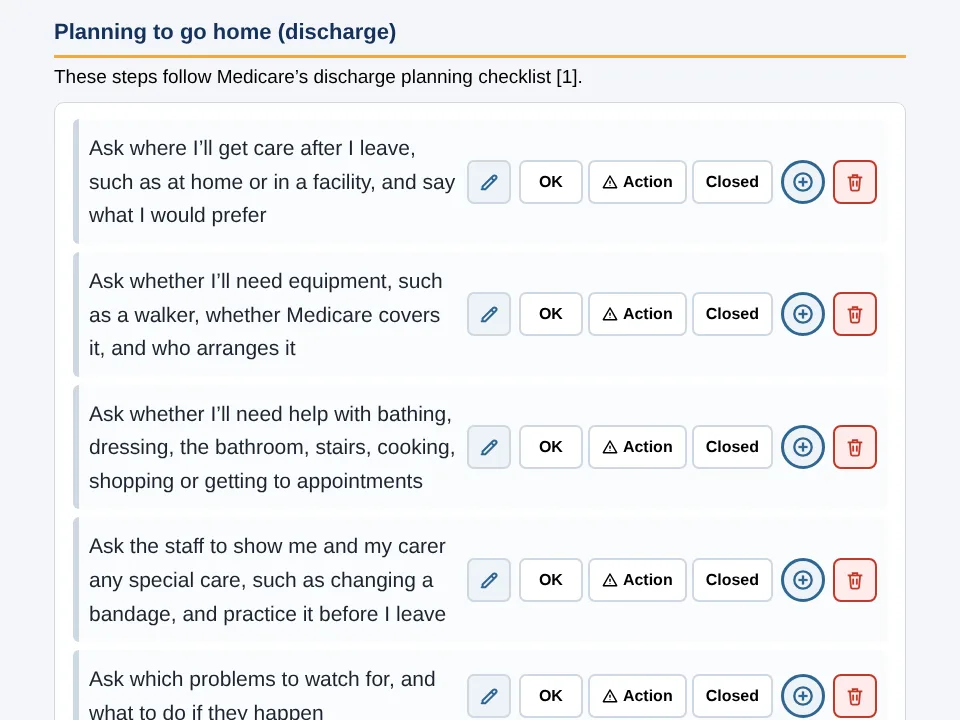
Planning to go home (discharge)
These steps follow Medicare’s discharge planning checklist [1].
- Ask where I’ll get care after I leave, such as at home or in a facility, and say what I would prefer
- Ask whether I’ll need equipment, such as a walker, whether Medicare covers it, and who arranges it
- Ask whether I’ll need help with bathing, dressing, the bathroom, stairs, cooking, shopping or getting to appointments
- Ask the staff to show me and my carer any special care, such as changing a bandage, and practice it before I leave
- Ask which problems to watch for, and what to do if they happen
- Go through my medicine list with the staff: which to continue, stop or change, and at what dose
- Ask for written discharge instructions and a summary of my health
- Write down my follow-up appointments
- Write down the names and phone numbers to call with questions
- Ask a social worker or my health plan about costs and coverage
- If I think I’m being sent home too soon, ask about a fast appeal
For the carer
From the caregiver section of Medicare’s checklist [1].
- Write down my questions about the discharge instructions
- Make sure I can give the help that’s needed, get any training, and arrange extra help before discharge
- Write down a contact name and phone number at the hospital
- Fill prescriptions and do the errands before the person comes home
Fact References
Every fact on this page comes from a named source. The numbers in square brackets above match the list below. Links were checked on November 9, 2026.
[1] Medicare (Centers for Medicare & Medicaid Services). "Your Discharge Planning Checklist." CMS Product No. 11376, December 2025. https://www.medicare.gov/publications/11376-your-discharge-planning-checklist.pdf (opens in a new tab) Accessed November 9, 2026.
[2] Medicare (Centers for Medicare & Medicaid Services). "Are You a Hospital Inpatient or Outpatient? If You Have Medicare - Ask!" CMS Product No. 11435. https://www.medicare.gov/publication-ordering/11435 (opens in a new tab) Accessed November 9, 2026.
Need help now?
- Someone in danger, or a medical emergency: call 911.
- Thinking about suicide, or worried about someone: call or text 988, the 988 Suicide & Crisis Lifeline (988 Lifeline (opens in a new tab)).
- Worried an older person is being abused, neglected or exploited: contact your local Adult Protective Services. The Eldercare Locator, 1-800-677-1116, weekdays 9 a.m. to 8 p.m. Eastern, can put you in touch (HHS (opens in a new tab)).
- Lost money or shared details with a scammer: call your bank or card company first, then the National Elder Fraud Hotline, 833-372-8311, Monday to Friday, 10 a.m. to 6 p.m. Eastern (U.S. Department of Justice (opens in a new tab)), or the AARP Fraud Watch Network Helpline, 877-908-3360 (AARP (opens in a new tab)).
- Report a scam: ReportFraud.ftc.gov (opens in a new tab) (Federal Trade Commission), and online crime at ic3.gov (opens in a new tab) (FBI).
General information for readers in the United States, not legal, financial or medical advice. Found a mistake? See our Corrections Policy.