
Comes with the Carer Workbench
Prescription Label Shorthand
What prescription shorthand means in plain words: how often (QD, BID, TID, QID, PRN), when (AC, PC, QHS) and how to take it (PO, SL), with a simple check before every dose.

Comes with the Carer Workbench
What BID, PRN, QHS and other prescription shorthand mean, in plain words.
This is a preview: the whole page, so you can see what it covers. To fill it in on screen, save it and print it, it comes with the Carer Workbench, our everyday tool for family carers, in a standard and a dyslexia-friendly edition.
Some prescriptions and labels still use short Latin abbreviations. This guide explains the common ones in plain words [1]. Medication safety experts recommend writing several of them out in full, because they are easily misread [2]. If a label isn’t clear, ask your pharmacist to explain it, or to print the directions in plain words.
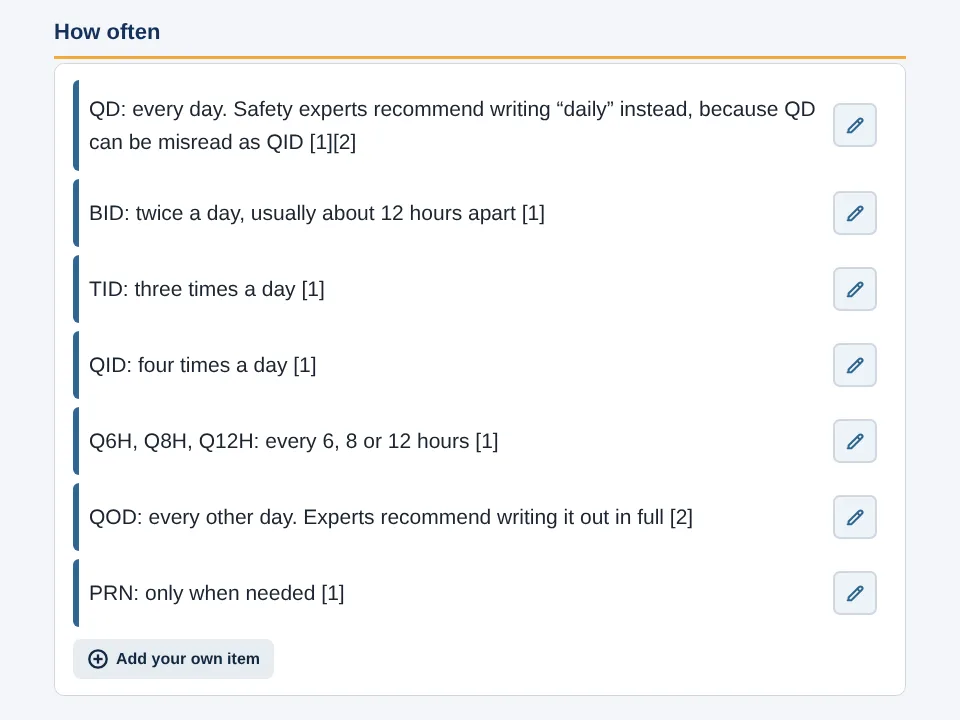
How often
- QD: every day. Safety experts recommend writing “daily” instead, because QD can be misread as QID [1][2]
- BID: twice a day, usually about 12 hours apart [1]
- TID: three times a day [1]
- QID: four times a day [1]
- Q6H, Q8H, Q12H: every 6, 8 or 12 hours [1]
- QOD: every other day. Experts recommend writing it out in full [2]
- PRN: only when needed [1]
When to take it
- AC: before meals [1]
- PC: after meals [1]
- HS or QHS: at bedtime [1]
How to take it
- PO: by mouth [1]
- SL: under the tongue, to dissolve [1]
- Top: on the skin [1]
- SUBQ: under the skin, as an injection [2]
- gtt or gtts: drop or drops [1]
- tab: tablet. cap: capsule [1]
- mL: milliliters, the measure experts recommend instead of “cc” [2]
A simple check before every dose
- The right person: the name on the label is the person taking it
- The right medicine: the name on the label matches the medicine list
- The right dose: how many tablets, or how much liquid
- The right time: the time of day, and before or after food
- The right way: by mouth, under the tongue, on the skin, and so on
Ask your pharmacist
- To explain any direction you’re not sure about
- For labels in larger print
- What to do if a dose is missed
- How to measure a liquid medicine
Fact References
Every fact on this page comes from a named source. The numbers in square brackets above match the list below. Links were checked on November 9, 2026.
[1] Drugs.com. "Top 150 Prescription Abbreviations and Their Medical Meanings." Medically reviewed by Leigh Ann Anderson, PharmD, updated October 30, 2026. https://www.drugs.com/article/prescription-abbreviations.html (opens in a new tab) Accessed November 9, 2026.
[2] Institute for Safe Medication Practices (ISMP). "ISMP List of Error-Prone Abbreviations, Symbols, and Dose Designations." 2024. https://online.ecri.org/hubfs/ISMP/Resources/ISMP_ErrorProneAbbreviation_List.pdf (opens in a new tab) Accessed November 9, 2026.
Need help now?
- Someone in danger, or a medical emergency: call 911.
- Thinking about suicide, or worried about someone: call or text 988, the 988 Suicide & Crisis Lifeline (988 Lifeline (opens in a new tab)).
- Worried an older person is being abused, neglected or exploited: contact your local Adult Protective Services. The Eldercare Locator, 1-800-677-1116, weekdays 9 a.m. to 8 p.m. Eastern, can put you in touch (HHS (opens in a new tab)).
- Lost money or shared details with a scammer: call your bank or card company first, then the National Elder Fraud Hotline, 833-372-8311, Monday to Friday, 10 a.m. to 6 p.m. Eastern (U.S. Department of Justice (opens in a new tab)), or the AARP Fraud Watch Network Helpline, 877-908-3360 (AARP (opens in a new tab)).
- Report a scam: ReportFraud.ftc.gov (opens in a new tab) (Federal Trade Commission), and online crime at ic3.gov (opens in a new tab) (FBI).
General information for readers in the United States, not legal, financial or medical advice. Found a mistake? See our Corrections Policy.