
Blog · Medication safety
How Can I Help My Parent Remember to Take Their Medications?
Forgetting a pill now and then happens to everyone. When it keeps happening to a parent, a few simple habits, set up together, can make each day easier for both of you.


Quick answer
Start by asking your parent what makes it hard, then build on habits they already have. Tie each dose to something they do every day, such as a meal or brushing their teeth, and set an alarm on a clock or phone (MedlinePlus (opens in a new tab)). A weekly pill box and a chart with a box to check off for each dose help settle the question "Did I take it?" (NIA (opens in a new tab); MedlinePlus (opens in a new tab)). A call or visit from family at dose time helps too. If remembering is still hard, tell their doctor, who may be able to cut back on medicines (MedlinePlus (opens in a new tab)).
Start with a conversation
Most older adults take at least one prescription medicine. In 2021 and 2022, 88.6% of adults 65 and older took a prescription medicine in the past year (CDC (opens in a new tab)). So your parent is far from alone in juggling pills, and the aim is to help, not to take over.
Before you buy anything, ask what gets in the way. Is it forgetting? Too many pills at different times? A label that is hard to read? If it's the label, the pharmacist can print it in larger type (NIA (opens in a new tab)).
Cost can be part of it too. In the same national survey, 3.4% of adults 65 and older had not taken their medicine as prescribed in the past year because of the cost (CDC (opens in a new tab)). If money is a worry, that's worth raising gently, and worth mentioning to the doctor or pharmacist.
Whatever you set up, set it up together. A system your parent chose is one they are more likely to keep.
Tie each dose to a daily habit
Habits do a lot of the remembering. Some people use meals or bedtime as their reminder (NIA (opens in a new tab)). Others take their medicine when they do something they never forget, like feeding the pet or brushing their teeth (MedlinePlus (opens in a new tab)).
If medicines go with meals, keep the pill box or bottles near the kitchen table. Check with the doctor or pharmacist first, because some medicines need to be taken on an empty stomach (MedlinePlus (opens in a new tab)).
Keep the medicines in one place that is easy to reach, and out of reach of visiting grandchildren (MedlinePlus (opens in a new tab)). Make sure that place has good light. It's easy to make a mistake taking medicine in the dark (NIA (opens in a new tab)).
Alarms, apps and automatic dispensers
An alarm is a gentle nudge that never forgets. Set one on a clock, a computer or a phone for each medicine time (MedlinePlus (opens in a new tab)). Timers, written reminders and medication reminder apps on a smartphone work too (NIA (opens in a new tab)).
For some people, an automatic pill dispenser helps. It holds 7 to 28 days of pills, gives them out up to 4 times a day, and uses a blinking light and an alarm when a dose is due (MedlinePlus (opens in a new tab)). Someone still has to fill it. It also won't let your parent take pills out early, which can be a problem when they are going out (MedlinePlus (opens in a new tab)).
A pill box and a check-off chart
Charts, calendars and weekly pill boxes are simple reminders that many people use (NIA (opens in a new tab)). Pill organizers come in 7, 14 or 28 days, with up to four compartments a day. The pharmacist can help your parent choose one that suits their medicines (MedlinePlus (opens in a new tab)). Another idea is a color mark on each bottle for the time of day, such as green for breakfast and blue for dinner (MedlinePlus (opens in a new tab)).
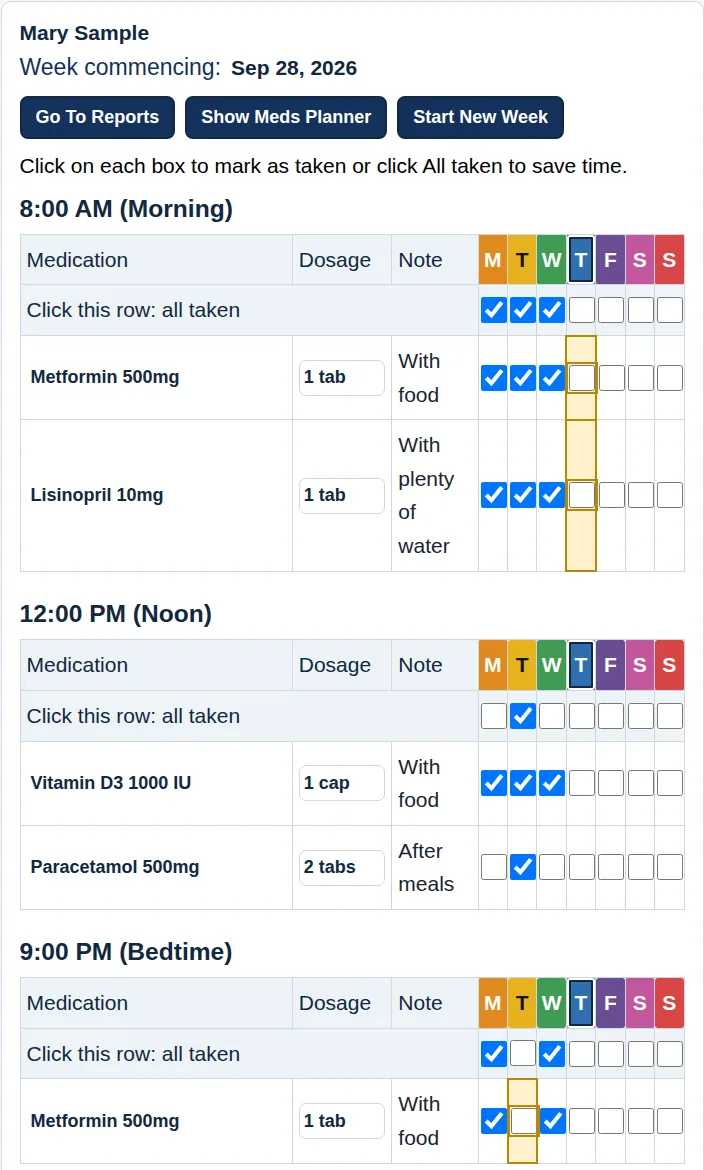
Pair the box with a medicine chart. List each medicine and the time it is taken, with a space to check it off once it's done (MedlinePlus (opens in a new tab)). That check mark answers "Did I already take it?" for your parent, and for you when you visit. Our posts on how to organize pills and how to keep a medication list go step by step.
Ed's tip, from Stay Safe at Home: Ask the pharmacy about a blister pack, where they sort your medicines by date and time for you.
If your parent likes a screen, our Health Record does the same job. They plan their medicines once, with a photo of each pill, tick off each dose as they take it, and see at a glance what's overdue. It's a paid tool with a free 30-day trial.
Calls, visits and a buddy
A friendly voice can be a good reminder. A family member can stop by or call at medicine time (MedlinePlus (opens in a new tab)). Your parent could also set up a buddy system with a friend, with phone calls to remind each other (MedlinePlus (opens in a new tab)).
Offer to go along to doctor's appointments too. A friend or relative there can help understand and remember what the doctor says (NIA (opens in a new tab)). If you live far away, our guide on helping a parent from a distance has more ideas, and our Carer Workbench is built for family carers.
When to tell the doctor or pharmacist
If your parent often misses doses, or has trouble remembering to take their medicines, tell their doctor. The doctor may be able to cut back on the number of medicines (MedlinePlus (opens in a new tab)). Tell the doctor too if your parent isn't sure what to do after a missed or forgotten dose (MedlinePlus (opens in a new tab)).
One thing matters most: your parent should not stop a medicine on their own (MedlinePlus (opens in a new tab)). Any change to a medicine is a decision for them and their doctor. Your part is to help them notice what isn't working and say so.
Questions people ask
What's the easiest way to help my parent remember their pills?
Tie each dose to a daily habit, such as a meal or brushing teeth, and set an alarm on a clock or phone (MedlinePlus (opens in a new tab)). A weekly pill box and a chart to check off each dose help too (NIA (opens in a new tab)).
Are automatic pill dispensers worth it?
They suit some people. They hold 7 to 28 days of pills and use a blinking light and an alarm when a dose is due. Someone still has to fill them, and they don't let you take pills out early, which can be awkward away from home (MedlinePlus (opens in a new tab)).
My parent keeps forgetting doses. What should we do?
Tell their doctor. The doctor may be able to cut back on medicines. Don't let your parent stop a medicine on their own (MedlinePlus (opens in a new tab)).
Is it common for older adults to skip medicines because of cost?
It happens. In 2021 and 2022, 3.4% of adults 65 and older had not taken their medicine as prescribed in the past year because of the cost (CDC (opens in a new tab)). If cost is a worry, mention it to the doctor or pharmacist.
Need help now?
- Someone has collapsed, has a seizure, has trouble breathing or can't be woken: call 911.
- Took the wrong medicine, or too much: call Poison Help at 1-800-222-1222. It's free and confidential, 24 hours a day (HRSA (opens in a new tab)).
- Thinking about suicide, or worried about someone: call or text 988, the 988 Suicide & Crisis Lifeline (988 Lifeline (opens in a new tab)).
- A question about your own medicines: ask your pharmacist or doctor. This blog is general information, not medical advice.
Sources
Each source was checked on November 9, 2026 unless a different date is shown.
- Taking medicine at home - create a routine. MedlinePlus Medical Encyclopedia, U.S. National Library of Medicine, reviewed July 15, 2026. https://medlineplus.gov/ency/patientinstructions/000613.htm (opens in a new tab)
- Keeping your medicines organized. MedlinePlus Medical Encyclopedia, U.S. National Library of Medicine, reviewed July 15, 2026. https://medlineplus.gov/ency/patientinstructions/000600.htm (opens in a new tab)
- Taking Medicines Safely as You Age. National Institute on Aging, reviewed September 22, 2022. https://www.nia.nih.gov/health/medicines-and-medication-management/taking-medicines-safely-you-age (opens in a new tab)
- Cohen RA, Mykyta L. Prescription Medication Use, Coverage, and Nonadherence Among Adults Age 65 and Older: United States, 2021-2022. National Health Statistics Reports No. 209, National Center for Health Statistics, CDC, September 5, 2024. https://stacks.cdc.gov/view/cdc/160016 (opens in a new tab)
General information for readers in the United States, not medical advice. Always talk with your doctor or pharmacist before you change how you take a medicine. This post contains no affiliate links. Found a mistake? See our Corrections Policy.