
Free wallet card
In Case of Emergency Wallet Card
A free In Case of Emergency wallet card for seniors: what to write on it, from emergency contacts and doctor to conditions, allergies and medicines, and how to keep it current.

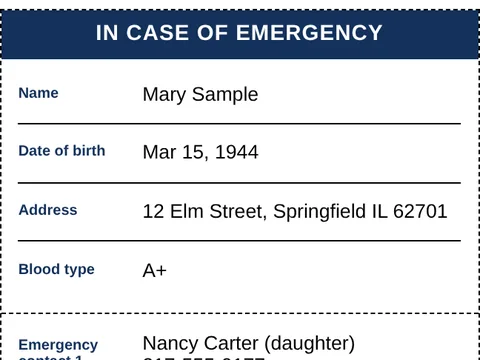
Use it free
Fill this in, print it, and cut along the border. Fold it twice and it is the size of a credit card, so it fits a wallet. Carry one copy, and give the other to a family member or your emergency contact.
This page shows the whole card so you can read it here. To fill it in on screen, save it and print it, open the interactive version. It's free, with no sign-up.
Open the interactive card (opens in a new tab) Add it to my Toolkit (opens in a new tab)
What goes on the card
- Name
- Address
- Date of birth
- Emergency contact 1 (name & phone)
- Emergency contact 2 (name & phone)
- Doctor (name & phone)
- Pharmacy (name & phone)
- Medical conditions
- Allergies
- Current medications (brief)
- Blood type
- Medical alert device / monitoring service
Keep it current
Update this card whenever a medication, contact, or condition changes. A wallet card is only useful if it's accurate.
Need help now?
- Someone in danger, or a medical emergency: call 911.
- Thinking about suicide, or worried about someone: call or text 988, the 988 Suicide & Crisis Lifeline (988 Lifeline (opens in a new tab)).
- Worried an older person is being abused, neglected or exploited: contact your local Adult Protective Services. The Eldercare Locator, 1-800-677-1116, weekdays 9 a.m. to 8 p.m. Eastern, can put you in touch (HHS (opens in a new tab)).
- Lost money or shared details with a scammer: call your bank or card company first, then the National Elder Fraud Hotline, 833-372-8311, Monday to Friday, 10 a.m. to 6 p.m. Eastern (U.S. Department of Justice (opens in a new tab)), or the AARP Fraud Watch Network Helpline, 877-908-3360 (AARP (opens in a new tab)).
- Report a scam: ReportFraud.ftc.gov (opens in a new tab) (Federal Trade Commission), and online crime at ic3.gov (opens in a new tab) (FBI).
General information for readers in the United States, not legal, financial or medical advice. Found a mistake? See our Corrections Policy.